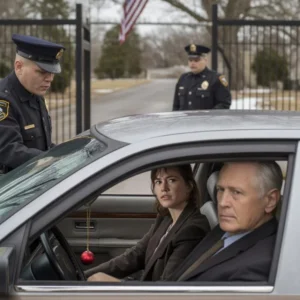
I stood at the chapel entrance clutching a wreath, only to be blocked by my mother’s husband. He whispered that I had lost the right to mourn her, signaling security to drag me toward the parking lot. But as the heavy oak doors slammed shut, a fleet of black sedans screeched to a halt.
A woman the entire country believed was dead stepped out, stared down the stunned crowd, and commanded, “Do not bury my daughter yet. I have not signed off on her death.”
My name is Kinsley Roberts, and at thirty-eight years old, I have spent the last fifteen years of my life dissecting the anatomy of lies.
I work as a senior forensic auditor for Harborgate Forensics in Richmond, Virginia. My job is not merely about mathematics. It is about human behavior. I look for the hesitation in a handwritten mark, the ghost data in a deleted file, and the silence where a number should speak.
I track the invisible bleed of money people think they have scrubbed clean. When a CEO siphons millions, I am the one who finds the three-dollar coffee charge that brings the whole house of cards down.
I am professional. I am clinical. I am used to being the smartest person in the room.
But standing on the tarmac at the Richmond airport, clutching a garment bag that contained a black dress I had bought twenty minutes prior, I felt like a child who had lost her way in the dark.
The call had come from a hospital administrator. Not my family.
Denise Marlo—my mother—was dead. Sudden cardiac arrest.
They said it like it was a phrase that could fit on a clipboard. A phrase that felt too small, too sterile, to contain the magnitude of the loss.
I had not spoken to my mother in six months.
It was not a fight exactly. It was a drifting. A silence that had grown heavy and calcified until neither of us knew how to break it.
I had buried myself in casework at Harborgate, telling myself that next week I would drive over. Next week, I would call.
Now, there were no more weeks.
I drove to the chapel in a rental car that smelled of stale cigarettes and pine air freshener. The steering wheel felt foreign in my hands. I had changed into my funeral clothes in the airport bathroom, and the fabric was stiff, the creases from the store still sharp against my skin.
I felt like an impostor in my own grief.
The chapel was an imposing structure of gray stone and stained glass, looming against a sky that threatened rain. It was the kind of place Graham Kesler would choose.
Graham was my mother’s second husband, a man who wore expensive suits that never quite fit his posture, as if he were constantly shrinking away from his own reflection.
He had two children from his previous marriage—Belle, and a son whose name I always struggled to recall in the heat of the moment, though I knew it was Trent.
They were adults now, polished and sharp-edged, always looking at me as if I were a smudge on a wine glass.
I parked the car and walked toward the heavy oak doors. My chest was tight, a physical pressure that made it hard to draw a full breath.
I just wanted to see her.
I needed to see her face one last time to make it real—to close the loop of guilt that was tightening around my throat.
I reached for the handle of the chapel door, but it did not turn.
Instead, it swung open from the inside, and Graham Kesler stepped out, blocking the threshold.
He was flanked by Belle and Trent, forming a wall of expensive black wool and hostility.
Graham looked at me, his eyes dry and hard. He did not look like a grieving widower. He looked like a bouncer at a club where I was not on the list.
“Kinsley,” he said, his voice flat. “You should not be here.”
I blinked, the words taking a moment to process through the fog in my brain.
“What are you talking about, Graham? She is my mother. Move out of the way.”
“She was your mother,” Belle corrected, her voice dripping with a faux sympathy that was more insulting than a slap. She smoothed the lapel of her blazer. “But you lost the right to that title months ago. You abandoned her.”
“I did not abandon her,” I said, my voice rising. I could feel the heat climbing up my neck. “We were busy. Life happens. I am here now. Let me in.”
Graham took a step forward, invading my personal space. He smelled of scotch and peppermint, a combination that made my stomach turn.
“Denise gave specific instructions,” he said. “Kinsley, she was heartbroken by your silence. She told us quite clearly that if anything happened to her, she did not want you parading your guilt at her funeral.”
He leaned in slightly, as if the cruelty would land better at close range.
“You are not on the family list. You are not welcome.”
My mind reeled.
That sounded nothing like my mother.
Denise was soft, sometimes to a fault. She was a woman who forgave slights before they were even fully committed. She would never ban her only daughter from her funeral.
It was illogical. It was a deviation from the baseline behavior I had known for thirty-eight years.
“You are lying,” I said, my voice trembling—not with sadness, but with the cold vibration of rage. “Mom would never say that. Show me her written instructions. Show me proof.”
“This is not a deposition,” Graham snapped.
“Kinsley,” Trent sneered from behind his father. “It is a funeral. Have some respect and leave.”
“I am not leaving until I see her,” I said, planting my feet.
Graham sighed, a theatrical exhale of a man burdened by an unruly child. He lifted his hand and signaled to two men standing in the shadows of the portico.
They were large, wearing security uniforms that looked a little too tactical for a house of worship.
They stepped forward, their expressions blank.
“Escort Miss Roberts to her vehicle,” Graham ordered. “Ensure she leaves the premises.”
As the guards moved toward me, my phone buzzed in my pocket.
It was a reflex to check it—a habit drilled into me by years of high-stakes auditing where a single email could change a case.
I pulled it out, stepping back to avoid the reaching hand of the first guard.
It was a calendar notification.
But not mine.
Months ago, I had synced my mother’s calendar to mine because she kept forgetting her cardiology appointments. I had never unsynced it.
The notification on my screen read:
Wells Fargo — 10:30 a.m.
I stared at it.
Today was Tuesday. The appointment was for today.
My mind, trained to spot anomalies instantly, overlaid this data point with the information I had seen on the digital obituary notice Graham had posted online earlier.
The notice—read in the taxi—stated that Denise Marlo had passed away peacefully in her sleep at 9:00 a.m. yesterday.
But as I looked at the notification, I remembered something else.
I swiped open my banking app.
I was a co-signer on one of her old emergency accounts, a small checking account she used for groceries. We rarely used it, but I still had visibility.
I scrolled back.
There was a pending transaction: a witness-stamp fee dated yesterday.
Timestamp: 4:00 p.m.
My heart stopped.
The obituary said she died at 9:00 in the morning. The death paperwork Graham had likely already filed to expedite this funeral would match that time.
But at 4:00 in the afternoon—seven hours after she was supposedly dead—someone had used her debit card to pay a witness-stamp fee at a bank branch downtown.
Dead women do not authenticate paperwork.
The discrepancy hit me with the force of a physical blow.
This was not just a family squabble.
This was fraud.
This was a cover-up.
The auditor in me woke up cold and sharp, pushing the grieving daughter aside.
“Wait,” I said, looking up at Graham. The tears were gone from my eyes. “Why did Mom have a witness-stamp transaction yesterday afternoon—seven hours after you said she died?”
Graham’s face went pale.
It was subtle—a tightening of the muscles around his mouth, a flicker in his eyes.
He knew.
He did not know I knew, but he knew there was a loose thread.
“You are hysterical,” Graham hissed. “Get her out of here. Now.”
The guards grabbed my arms.
Their grip was bruising, painful.
I struggled, digging my heels into the concrete.
“Let go of me. You are hiding something, Graham. Why are you burying her so fast? Why is the timeline wrong?”
“Drag her,” Graham spat, losing his composure. “Throw her in the street if you have to.”
I was being hauled backward, my heels scraping against stone.
The heavy doors of the chapel began to close, sealing the secrets inside.
I saw Belle’s smirk—a small victorious curve of red lips.
They were going to erase me.
They were going to bury my mother with her secrets, and I was going to be left in the parking lot with nothing but questions.
I screamed, a raw, guttural sound of frustration.
But the doors slammed shut with a final booming thud.
I was alone with the guards. They were dragging me toward the parking lot, their grip unyielding.
“Let me go,” I gasped, trying to catch my breath. “I can walk.”
They ignored me.
We were halfway to my rental car when the sound cut through the air.
It was the screech of tires.
Not just one car.
A convoy.
A fleet of four black sedans, polished to a mirror shine, tore into the church driveway. They moved with aggressive precision, ignoring the painted lanes, swerving around the hearse, and coming to a halt directly in front of the chapel entrance—blocking the hearse completely.
The sound of doors opening was synchronized.
Click. Clack.
Like the loading of a weapon.
The guards holding me froze. Their grip loosened just enough for me to wrench my arms free.
We all turned to look.
From the lead car, a driver in a dark suit stepped out and opened the rear passenger door.
He did not look like a chauffeur.
He looked paramilitary.
A leg emerged—a black heel, sharp and terrifyingly high.
Then the rest of her followed.
The woman was tall, her posture erect and unyielding as a steel beam. She wore a black morning suit that looked like it cost more than the chapel itself. Her hair was silver, cut in a sharp bob that framed a face made of angles and ice.
She wore dark sunglasses, but even without seeing her eyes, I felt the weight of her gaze.
The air in the parking lot seemed to drop ten degrees.
I stopped breathing.
I knew that face.
I had seen that face in newspapers, in magazines, and in the nightmares of my childhood.
I had seen that face on the front page of the Wall Street Journal five years ago under the headline:
“Billionaire matriarch Evelyn H. Hallstead perishes in helicopter crash off the Amalfi Coast.”
Evelyn Hallstead.
My grandmother.
The woman who had disowned my mother twenty years ago for marrying a mechanic.
The woman who was supposed to be dead.
She stood there adjusting her leather gloves.
Alive.
Very, very alive.
Graham and his children burst out of the chapel doors, likely alerted by the noise.
They stopped dead on the steps.
Graham looked as if he had seen a ghost. His mouth opened, but no sound came out.
Evelyn did not look at me. She did not look at the guards.
She walked straight toward the chapel doors, her heels clicking on the pavement with a rhythmic, terrifying cadence.
Graham found his voice, though it was a strangled squeak.
“Evelyn… that is impossible. We buried you.”
Evelyn stopped at the bottom of the stairs. She slowly removed her sunglasses.
Her eyes were the same color as mine—piercing storm-cloud gray.
But hers held a power I had never possessed.
“You buried an empty casket, Graham,” she said.
Her voice was not loud, but it carried across the lot like a crack of thunder. It was a voice used to commanding boardrooms and dismantling companies.
“And now you are trying to bury my daughter before the ink is dry.”
She turned her head slightly, acknowledging me for the first time.
It was a brief, assessing glance—devoid of warmth, but full of recognition.
Then she looked back at Graham.
“Get out of my way,” Evelyn said. “You have no authority here.”
Graham stammered, though he was stepping back, his body betraying his cowardice.
“This is a private funeral. Denise is gone.”
Evelyn ascended the stairs.
The guards who had been manhandling me moments ago stepped aside, heads bowed—instinctively recognizing the presence of a predator far higher on the food chain than their pay grade allowed them to challenge.
She stopped inches from Graham’s face.
She was almost as tall as he was, but in that moment, she towered over him.
“I am the authority,” she said perfectly clearly. “And I am telling you this only once. Do not bury my daughter yet. I have not signed for her death.”
She pushed past him.
The physical contact shocked the crowd into silence.
She walked through the open doors of the chapel into the gloom where my mother lay.
I stood in the parking lot, my wrist still throbbing where the guards had held me.
My world had just tilted on its axis.
The mother I loved was dead.
The grandmother I feared was alive.
And the stepfather I despised was shaking in his shoes.
I looked at the phone in my hand, at the notification of the bank appointment, the numbers, the discrepancies.
Evelyn H. Hallstead had just bought me time.
I did not know how, and I did not know why, but she had kicked the door open.
Now it was my turn to walk through it and find out why the numbers did not add up.
I straightened my jacket, took a deep breath of the humid air, and followed the dead woman into the church.
The silence inside the chapel was not peaceful. It was the heavy, suffocating silence of a bomb that had landed but failed to detonate.
I followed Evelyn Hallstead down the center aisle, the sound of her heels striking the marble floor echoing like gunshots in a canyon.
Every head turned.
The mourners—a mix of Graham’s business associates, my mother’s distant relatives, and the social climbers of Richmond—looked as though they were witnessing a resurrection, or perhaps an execution.
Evelyn did not look at them. She walked with a singular predatory focus toward the mahogany casket resting on the dais.
The air smelled of lilies and floor wax, a cloying scent that made my stomach churn.
I kept my distance, staying three paces behind her, my mind frantically trying to reconcile the woman in front of me with the obituary I had read five years ago.
I had mourned her.
I had moved on.
And now here she was, parting the sea of black suits like a biblical figure, returning to exact judgment.
She stopped at the foot of the casket.
She did not reach out to touch the wood. She did not weep.
She simply stared at the closed lid as if she could see through the mahogany to the body beneath.
Her face was a mask of cold porcelain, devoid of the messy, wet grief staining the faces of everyone else in the room.
The funeral director—a man named Mr. Abernathy, whom I had met briefly years ago—stepped forward.
He was trembling. His hands fluttered around his tie as he tried to block Evelyn’s path without actually touching her.
“Madam,” he stammered, his voice cracking, “we are in the middle of a service. You cannot simply—”
Evelyn turned her head slowly.
It was a mechanical movement, precise and terrifying.
“Halt the proceedings, Mr. Abernathy. Do not seal this casket. Do not transport it to the crematorium.”
Graham Kesler scrambled up the steps of the dais, his face a muddled map of red rage and white panic.
He looked like a man watching his house burn down with his insurance policy locked inside.
“This is a farce!” Graham shouted, pointing a shaking finger at Evelyn. “This woman is an impostor, a lunatic—security! Get her out. She is disrupting the sanctity of my wife’s funeral.”
“Sanctity?” Evelyn repeated, tasting the word like something rotten.
She turned to face the congregation, her voice projecting effortlessly to the back row without the need for a microphone.
“Graham speaks of sanctity while he rushes a cremation. Tell me, Graham—since when does the Kesler family rush anything that does not involve a payout?”
“You are dead!” Graham screamed, losing control. “We saw the reports—the helicopter, the crash.”
“I am standing right here,” Evelyn said calmly, “which suggests the reports were somewhat exaggerated.”
She turned back to the funeral director.
“Mr. Abernathy, you will pause this service immediately. You will secure the remains in your climate-controlled holding facility, and you will ensure that no member of the Kesler family—specifically Graham, Belle, or Trent—has access to the body.”
Mr. Abernathy looked from Graham to Evelyn, sweat beating on his forehead.
“I take my instructions from the next of kin. Madam, Mr. Kesler is the husband. He has the legal authority.”
Evelyn reached into her black clutch and pulled out a sleek gold card.
“Mr. Kesler might have the marriage certificate, but I have the leverage.”
She did not raise her voice. She did not have to.
“The Sapphire Trust, which I control, owns the land this chapel sits on. We fund your preservation guild. We pay for the restoration of your stained glass. If you move that body one inch closer to a furnace before I give the word, I will foreclose on this building by noon tomorrow and turn it into a parking garage.”
The threat hung in the air—absolute and credible.
Mr. Abernathy swallowed hard. He looked at Graham, then back at Evelyn.
The calculus of survival was simple.
“We will pause the service,” Mr. Abernathy announced, his voice weak. “Please, everyone—if you could clear the room. We need a moment of privacy.”
Pandemonium broke out.
The whispers turned into a roar.
Graham looked ready to physically attack Evelyn, but Trent held him back, whispering furiously in his ear.
Belle was staring at me, her eyes narrowed, calculating the new variables.
Evelyn did not wait for the room to clear.
She turned to me, her gray eyes locking onto mine.
For the first time, I saw a flicker of something human there—exhaustion perhaps, or urgency.
“Kinsley,” she said.
It was not a greeting.
It was a summons.
“With me. Now.”
She marched toward the vestry—a private room to the left of the altar used for grieving families.
I followed her, my legs feeling like lead.
I passed Graham, who hissed something unintelligible at me, but I did not stop.
I stepped into the vestry, and Evelyn slammed the heavy door behind us, turning the lock with a definitive click.
The room was small, lined with dark wood and furnished with velvet chairs that looked uncomfortable.
Evelyn dropped her clutch on a side table and leaned against the wall, letting out a long, slow breath.
The steel posture softened for just a second, revealing a woman who was eighty years old and carrying the weight of the world.
“Grandmother,” I said, the word feeling foreign on my tongue. “You are supposed to be at the bottom of the Mediterranean Sea.”
“And you are supposed to be a forensic auditor,” she snapped, the steel returning instantly. “So stop staring at me like I’m a ghost and start thinking like a professional.”
“You faked your death,” I said, my mind racing to catch up. “Why? For five years, Mom cried for months. We held a memorial. We buried an empty box.”
“It was necessary,” Evelyn said, walking over to the small window and peering through the blinds at the parking lot. “There was a hostile faction within the consortium. I am not talking about corporate raiders, Kinsley. I am talking about men who solve board disputes with car bombs.”
She turned back, eyes hard.
“They wanted the conglomerate. They wanted me out of the way to strip the assets. The only way to save the legacy and to ensure your mother’s safety was to remove the target. Dying on paper was the most efficient strategic move.”
“You left us,” I said, anger flaring up to replace the shock. “You let Mom believe she was an orphan.”
“I protected her,” Evelyn snapped. “If they knew I was in contact, she would have been leverage. Isolation was her shield. Or at least I thought it was.”
She walked over to the table and picked up a thick manila envelope that she had evidently brought with her.
She tossed it onto the coffee table between us. It landed with a heavy thud.
“Sit down,” she commanded.
I sat. My hands were shaking, so I clasped them in my lap.
“What is this?”
“This,” Evelyn said, tapping the envelope, “is a copy of a blind trust I established ten years ago. It has a dormant clause triggered only by the certified death of my daughter, Denise.”
She watched me carefully.
“Graham does not know it exists. His lawyers do not know it exists. But it effectively freezes the liquidity of the estate the moment her heart stopped beating.”
I looked at the envelope, then up at her.
“You came back because of the money.”
“I came back because Denise called me,” Evelyn said softly.
The room went silent.
The air-conditioning unit hummed in the background.
“Mom called you?” I asked.
“Three weeks ago,” Evelyn said. “She used a burner phone. She called a number that only three people on this planet possess. She sounded terrified. She did not give details. She knew the lines might not be secure.”
Evelyn leaned in, her eyes boring into mine.
“She just said one thing to me. She said, ‘Mother, if anything happens to me, do not let them bury me too fast. Promise me you will stop the clock.’”
A chill went down my spine, colder than the air in the chapel.
“She knew,” I whispered. “She knew something was going to happen.”
“She suspected,” Evelyn corrected, “and now she is dead. And her husband is trying to cremate her within thirty-six hours of her death, bypassing a full autopsy and claiming it was her wish.”
Evelyn’s gaze sharpened.
“Does that sound like the Denise you knew? The woman who kept every receipt, who documented every scrap of paper?”
“No,” I said. “It doesn’t.”
“You are standing in a funeral home, Kinsley,” Evelyn said, her voice dropping to a harsh whisper, “but do not be confused. You are not at a funeral. You are standing in the middle of an illicit asset transfer.”
Her fingers tightened around the edge of the table.
“They are not trying to say goodbye to her. They are trying to dispose of the evidence so they can unlock the vault.”
My mind flashed back to the discrepancies I had found.
“The bank appointment,” I said, glancing at my phone. “Mom had a witness-stamp appointment yesterday afternoon—hours after the death paperwork says she died. And the fee was paid. I saw the transaction.”
Evelyn nodded, not surprised.
“Good. You are waking up. Graham is sloppy. He is greedy, and greed makes men careless. He thinks he’s playing checkers, but he is sitting at a chess board.”
She reached into the envelope and pulled out a single sheet of paper.
It was a high-resolution printout of a digital image.
“I have my own resources,” Evelyn said. “When Denise died, my system flagged her accounts. We pulled the surveillance footage from the bank branch where that transaction took place yesterday.”
She slid the photo across the table toward me.
I looked down.
It was a black-and-white still from a security camera—grainy, but clear enough to make out faces.
It showed a desk at a bank.
Sitting on one side was a loan officer.
Sitting on the other side was my mother—or at least a woman wearing my mother’s coat, her scarf, and her signature oversized sunglasses.
Her hand was poised over a document, a pen in her grip.
“That is Mom,” I said, squinting. “That is her coat—the one I bought her for Christmas.”
“Look at the person standing behind her,” Evelyn said.
I shifted my gaze.
Standing just behind the woman’s chair, hand resting possessively on the back of the seat, was a figure.
I expected to see Graham. I expected to see his oily smile guiding her hand, forcing her to sign away her life.
But the figure was not Graham.
The person in the photo was tall, wearing a hoodie pulled low.
The build was wrong for Graham. Too slender. The posture was different.
And on the wrist—clearly visible as the person reached forward—was a distinct chunky silver bracelet.
I gasped.
“That is not Graham.”
“No,” Evelyn said grimly. “It is not.”
“Who is it?” I asked, looking up at her.
“I do not know yet,” Evelyn said. “But look at the timestamp: 4:15 yesterday afternoon.”
“She was supposed to be dead,” I said, my voice trembling.
“So either the death paperwork is a lie,” Evelyn finished for me, “or that is not your mother in the chair.”
“Or worse,” she continued, voice like iron, “your mother was alive yesterday afternoon, forced to sign that document, and then killed immediately after.”
I felt bile rise in my throat.
The image blurred before my eyes.
This wasn’t just fraud.
This was murder—cold, calculated, executed by people who claim to be family.
“Graham is involved,” I said. “He has to be. He’s the beneficiary.”
“He is the beneficiary,” Evelyn agreed. “But he is not smart enough to do this alone. He has a partner—or a handler.”
She snatched the photo back and shoved it into the envelope.
“Listen to me, Kinsley. I have stopped the cremation for now, but my legal hold is tenuous.”
Her eyes flicked toward the door.
“I am technically a dead woman. My lawyers are filing emergency injunctions to restore my status, but the courts are slow. We have forty-eight hours, maybe less, before Graham finds a judge to overturn my order or bribe the funeral home to burn the evidence anyway.”
“What do we do?” I asked.
The auditor in me was taking over fully now. The grief was boxed up, shoved into a dark corner to be dealt with later.
Now there was only the case.
“I handle the legal war,” Evelyn said. “I tie them up in knots. I make it impossible for them to touch a scent of the money without triggering a federal investigation.”
She grabbed my shoulders, her grip surprisingly strong.
“You are going to find out what really happened,” she said. “You are going to dig into the numbers. You are going to follow the paper trail Graham thinks he burned.”
Her voice dropped.
“You are going to find out who that person in the hoodie is. And you are going to prove they killed my daughter.”
“But Graham kicked me out,” I said. “I can’t get close to the house. I can’t get to her files.”
“You don’t need to get into the house yet,” Evelyn said. “You need to find the lawyer Denise was using—not the family lawyer. The one she hired in secret.”
“She had a secret lawyer?”
“She mentioned him in the call,” Evelyn said. “Caleb Ror. His office is downtown. If Denise left a breadcrumb trail, it starts on his desk. Go to him now—before Graham realizes he exists.”
“What about you?” I asked, standing up as she released me. “Where will you go?”
“I am going to stand guard over that body,” Evelyn said, her voice turning to ice. “I am going to sit in this chapel, and I am going to dare anyone to come through those doors with a match.”
She opened the vestry door.
The noise of the agitated crowd flooded back in.
“Go,” she commanded.
“And Kinsley—”
I turned back.
“Do not trust anyone,” she said. “Not even the people you think are on our side when a billion dollars is on the table. Loyalty is just a line item in a budget.”
I nodded, clutching my purse.
I walked out of the vestry, past the shocked faces of the mourners, past Graham screaming into a cell phone, and out into the humid Virginia air.
The game had changed.
I wasn’t just a daughter anymore. I was an auditor, and I was about to conduct the most important audit of my life.
The address Evelyn H. Hallstead had memorized and whispered to me belonged to a building in the financial district of Richmond, but not the part where the glass skyscrapers scratched the clouds.
Caleb Ror’s office was located in a squat brick structure sandwiched between a parking garage and a derelict printing shop. It was the kind of building that housed bail bondsmen and private investigators—people who made their living in the gray margins of the law.
I checked the rearview mirror for the fourth time since leaving the chapel.
The rain had started to fall, a steady gray drizzle that slicked the streets and blurred the windshield.
I did not see the black sedan that had been parked two rows over at the funeral home, but the sensation of being watched was a cold prickle at the base of my neck.
It was a feeling I knew well from my days auditing cartels—the primitive instinct that told a gazelle the grass was moving against the wind.
I parked my rental car a block away and walked, keeping my head down against the rain.
The lobby of the building smelled of lemon polish and old carpet.
The directory listed Ror Associates on the third floor.
I took the stairs, avoiding the elevator that looked like it hadn’t been inspected since the ’90s.
When I reached suite 304, the door was locked.
There was no receptionist, just a frosted glass pane with the name stenciled in peeling black letters.
I knocked—a sharp, authoritative wrap.
Silence.
I knocked again, harder.
“Mr. Ror. My name is Kinsley Roberts. Evelyn sent me.”
I heard the sound of a deadbolt sliding back, then a chain rattling.
The door opened a crack, revealing a slice of a face pale with anxiety.
Caleb Ror was a man in his late fifties with thinning hair that looked like it had been pulled by nervous hands. He wore a white dress shirt wrinkled at the elbows and a tie loosened hours ago.
“Come in,” he hissed, glancing past me into the empty hallway. “Quickly.”
I stepped inside, and he immediately slammed the door, engaging three separate locks.
He rushed to the window, peering through the slats of the blinds before yanking the cords to shut them tight.
The office was dimly lit, illuminated only by a green banker’s lamp on a desk buried under stacks of paper.
It smelled of stale coffee and fear.
“You should not have come here,” Caleb said, turning to face me, wiping his hands on a handkerchief. “It is not safe.”
“My mother is dead,” I said, my voice steady despite the adrenaline pumping through my veins. “Safety is no longer my priority. Evelyn told me you have answers.”
“Evelyn…” he breathed, sinking into his leather chair. The springs groaned under his weight. “I thought she was a ghost. When she called me this morning, I nearly had a heart attack.”
“Focus,” I said, stepping closer to the desk. “My mother hired you. Why? Graham has a team of corporate lawyers at the firm. Why did she need you?”
Caleb looked at the file cabinets lining the wall—metal coffins holding secrets.
“Because she knew she couldn’t trust the firm. She knew Graham was compromised.”
He opened a drawer and pulled out a manila folder, his hands trembling slightly.
“Your mother was terrified, Kinsley. She was not the woman you remember. She was paranoid. She made me install an encrypted server. She made me buy burner phones.”
His throat bobbed.
“She told me that if she died under any circumstances that were not clearly natural—and I mean clearly, like a lightning strike in a public park—I was to immediately file a motion for an independent autopsy.”
“She expected to be killed,” I said. The words tasted like ash.
“She expected an accident,” Caleb corrected. “She told me specifically: ‘If I fall down the stairs, Caleb, do not believe it. If my heart stops, do not believe it.’”
He shook his head, voice dropping.
“She knew they would make it look medical. She knew they had access to pharmacists and doctors who would sign whatever piece of paper was put in front of them for five thousand dollars.”
I leaned against the edge of his desk, my mind racing.
“The autopsy is already being blocked. Evelyn stopped the cremation, but Graham is fighting it. We need evidence to convince a judge to keep that body on ice.”
“I have something better than evidence of murder,” Caleb said. “I have the motive.”
He reached into his pocket and pulled out a small silver object.
A USB drive, worn at the edges.
He held it up, but did not hand it over.
“Denise was not just a victim,” Caleb said. A flicker of pride moved through his fear. “She was a fighter. She started paying attention to the papers Graham brought home. She started photographing documents when he was in the shower.”
He swallowed.
“She compiled a dossier.”
“What is on the drive?” I asked, eyeing the silver stick.
“A ledger,” Caleb said. “A shadow ledger. Graham and his partners have built a network of shell companies. They are funneling money out of the family trust, washing it through construction projects that never break ground and consulting firms that have no employees.”
He tapped the drive lightly.
“But there is a pattern. All the money eventually flows into one entity.”
“Blue Hollow Freight,” I said, remembering the name I had seen on a stray invoice in my mother’s email months ago—an odd detail I had dismissed at the time.
Caleb’s eyes widened.
“You know it.”
“I am a forensic auditor,” I said. “I see patterns. But I need proof. Give me the drive, Caleb.”
He hesitated. His fingers tightened around the metal.
“There is a second file on here. It is not financial. It is audio.”
My stomach clenched.
“Denise recorded a conversation between Graham and a man named Miles. I have not listened to the whole thing, but it is damning. It connects them to a larger syndicate.”
He looked toward the door, as if the walls could hear.
“If this gets out, people go to prison for twenty years—or they get killed.”
“Give it to me,” I repeated, extending my hand.
Just as his hand moved toward mine, a sound shattered the quiet of the room.
Buzz. Buzz. Buzz.
His cell phone sitting on the desk lit up, casting a harsh blue glow on his sweating face.
Caleb looked down at the caller ID.
The color drained from his face so completely he looked like a corpse himself.
He did not answer it. He did not reject it.
He simply reached out with a shaking finger and silenced the ringer, staring at the phone as if it were a bomb counting down.
“Who is it?” I asked.
“We are done,” Caleb said abruptly.
He shoved the USB drive back into his pocket. He did not give it to me.
“Caleb—give me the drive.”
“No.”
He stood up, knocking his chair over.
“You need to leave right now. You were never here.”
“You can’t just send me away,” I argued. “If they know I’m here, I’m already a target. The drive is safer with me.”
“They don’t know you are here,” he whispered, eyes darting to the door. “But they know I am here—and they just signaled that my time is up.”
He grabbed my arm and practically dragged me toward a side door hidden behind a coat rack.
“Wait,” I said, resisting. “What about the autopsy? What about the motion?”
“I will file it electronically,” he shouted, panic making his voice shrill. “Just get out. If you want to help your mother, stay alive.”
He shoved me through the door and slammed it shut.
I heard the lock click.
I was standing in a narrow, dimly lit service corridor that smelled of garbage and damp concrete.
My heart was hammering against my ribs.
I had the information, but I did not have the proof.
I knew about the shell companies. I knew about the recording.
But I was empty-handed.
I took a deep breath, trying to steady my hands.
I walked down the corridor, my heels clicking on the linoleum.
I decided against the fire escape. In this rain, a metal staircase was a death trap.
I would take the service elevator down to the lobby and exit through the side alley.
I pressed the button.
The mechanism groaned, and the door slid open with a rattle.
I stepped in, pressed the button for the ground floor, and waited.
The elevator descended slowly.
When the doors opened on the lobby level, I stepped out, intending to turn right toward the service exit.
I stopped dead.
Standing in the main hallway, directly in my path, was a woman.
She was examining a piece of abstract art on the wall with the bored detachment of a critic at a gallery opening.
It was Belle Kesler.
She was not wearing funeral attire anymore. She had changed into a cream-colored power suit that looked like it cost more than Caleb Ror’s entire annual salary.
Her hair was pulled back in a severe sleek ponytail, and she was holding a leather portfolio.
She turned slowly as I stepped out of the elevator.
She did not look surprised.
Her eyes, cool and predatory, swept over me from head to toe.
“Kinsley,” she said, her voice smooth as silk. “I didn’t peg you for the type to visit a dump like this.”
I stood my ground, clutching my purse strap.
“I could say the same for you, Belle. Graham usually keeps you in the penthouse.”
“Daddy has his errands. I have mine,” she said, taking a step toward me. The heels of her cream shoes were spotless, untouched by the rain outside. She had not walked here. She had been driven.
“I was just stopping by to drop off a settlement offer for Mr. Ror. We like to be proactive.”
“Is that what you call it?” I asked. “Proactive—or intimidation?”
Belle laughed—a short, sharp sound.
“You are so dramatic, just like your mother. Always seeing monsters in the shadows.”
She stopped a foot away from me.
I could smell her perfume—something expensive and floral, masking the damp lobby.
“What were you doing up there, Kinsley?” she asked softly. “Begging for scraps, hoping the old drunk had a secret stash of cash Denise hid from us?”
“I was looking for the truth,” I said. “Something you wouldn’t recognize if it hit you in the face.”
Belle’s smile faded. Her expression hardened into something ugly.
“Here is a truth for you, stepsister. You are playing a game you do not understand. You think because the old witch your grandmother rose from the grave, you have leverage.”
Her voice dropped, sweet and venomous.
“You don’t. You are just a nuisance, and nuisances get removed.”
She glanced toward the elevator.
“Did you get what you came for?” she asked. “A drop of fear from the lawyer, or a signature?”
“I got enough,” I lied.
“We’ll see,” Belle said.
She stepped aside, clearing the path to the door.
“Run along, Kinsley. Go back to your spreadsheets. Leave the real business to the adults.”
I walked past her, every instinct screaming at me not to turn my back.
I pushed through the heavy glass doors of the lobby and out into the rain.
I didn’t look back until I was in my car—doors locked, engine roaring to life.
As I drove away, I saw a black SUV idling across the street. The windows were tinted, but I knew who was inside.
I drove aimlessly for an hour, making random turns to ensure I wasn’t being followed, before checking into a motel on the outskirts of the city.
It was a nondescript place, the kind where people paid cash and didn’t ask questions.
I sat on the edge of the bed, staring at the blank television screen, my mind replaying the conversation with Caleb—the ledger, the recording, the fear in his eyes when the phone rang.
Why hadn’t he given me the drive?
Was he trying to leverage it himself?
Or was he trying to protect me by not letting me carry the physical evidence?
I ordered a pizza I didn’t eat and watched the rain streak against the window.
Night fell—heavy and suffocating.
At 11:00, I turned on the news.
The local station was covering a traffic accident on the interstate. I was about to turn it off when the breaking news banner flashed across the bottom of the screen:
Downtown office building fire.
My stomach dropped.
I turned up the volume.
The reporter was standing in the rain, illuminated by flashing red and blue lights of fire trucks. Behind her, smoke billowed from a brick building. Flames licked out of the third-floor windows.
“Firefighters are battling a two-alarm blaze at a commercial building on Fourth Street,” the reporter said, shouting over the roar of water hoses. “The fire appears to have started in a law office on the third floor. Authorities are saying early indications point to a massive electrical failure.”
I stared at the screen, my hand covering my mouth.
It was Caleb’s building.
It was Caleb’s office.
The camera zoomed in. The windows were blown out. The roof above the third floor had partially collapsed.
“We have reports that the office was occupied at the time,” the reporter continued grimly, “but due to the intensity of the heat, rescue crews have not been able to enter.”
“Electrical failure,” I whispered to the empty motel room.
It wasn’t.
I had seen those file cabinets. I had seen the stacks of paper.
It was a bonfire.
They hadn’t just burned the office.
They had burned the paper trail.
Every deposition, every affidavit, every note my mother had written to Caleb—ash now.
And Caleb…
I remembered the fear in his eyes, the phone call.
They knew he was there. They knew I was there.
They waited for me to leave—and then they struck.
Belle had been in the lobby.
The gatekeeper ensuring the timeline was respected.
I felt a wave of nausea followed by a cold, hard clarity.
They thought they had won.
They thought that by burning the paper, they had erased the problem.
But they had made a mistake.
Caleb hadn’t given me the drive, but he had told me what was on it.
He had told me about the network—Blue Hollow Freight.
And more importantly, arson is not a corporate strategy.
It is a felony.
They had escalated the war.
They had moved from fraud to violence.
I stood up and walked to the window.
The reflection in the glass looked tired, pale, and terrified.
But behind the fear, the forensic auditor was taking notes.
Fire destroys paper. It melts plastic.
But it leaves traces.
And if they thought they could burn the truth out of existence, they had never met a woman who could reconstruct a crime scene from a pile of ash.
I picked up my phone.
I needed to call Evelyn.
The second file was gone, but the war had just begun.
The fluorescent lights of Harborgate Forensics hummed with a frequency that usually soothed me. It was a white noise that drowned out the chaotic variables of the real world, replacing them with the binary certainty of ones and zeros.
I walked into the open-plan office at 8:00 in the morning, holding a cup of black coffee that I did not intend to drink.
I was wearing my work armor: a charcoal suit, a silk blouse, and a face that revealed absolutely nothing.
To my colleagues, I was just Kinsley Roberts returning from bereavement leave earlier than expected.
To the receptionist, I was the dedicated workaholic who used spreadsheets to cope with grief.
They offered me sad smiles and murmured condolences about my mother, which I accepted with a stiff nod.
They did not know that twenty-four hours ago, I had watched a lawyer’s office burn to the ground.
They did not know that the woman who raised me might have been murdered.
I sat at my desk and logged into the terminal.
The dual monitors flickered to life.
I felt a strange sense of dissociation, as if my hands belonged to a pianist preparing to play a concerto while the concert hall was on fire.
I was not here to work on my assigned cases.
I was here because Harborgate had access to databases the average citizen did not.
We subscribed to global corporate registries, asset tracking software, and deep-web scraping tools that could find a heartbeat in a stone.
I started with Blue Hollow Freight LLC.
Caleb Ror had given me the name before the fire took him—or at least took his practice.
I typed the name into the corporate registry search bar.
The results were underwhelming, which was exactly what I expected.
Blue Hollow was registered in Delaware, a state famous for corporate opacity.
The registered agent was a generic filing service that handled thousands of companies.
The address listed for its headquarters was a mail drop in an industrial park outside Baltimore.
I pulled the filing history.
The company was formed nine months ago.
The timeline made the hair on my arms stand up.
Nine months ago was when my mother had first mentioned feeling tired and foggy during our rare phone calls. It was when Graham had started taking over the household finances, claiming he wanted to alleviate her stress.
I cross-referenced Blue Hollow with the banking data I had managed to scrape from my mother’s shared account before Graham locked me out.
It was a small window of visibility, but it was enough.
I found a transaction—not to Blue Hollow directly, but to a company called Apex Consulting.
$5,000.
Paid for “advisory services.”
I ran Apex Consulting.
It was a shell—no website, no employees on LinkedIn. Its address was a suite in a strip mall in Nevada.
I looked at the Apex outflow.
They were sending monthly payments to another entity called Meridian Logistics.
I traced Meridian.
And there it was.
Meridian sent eighty percent of its incoming capital directly to Blue Hollow Freight.
It was a classic layering scheme.
The money moved through three distinct layers of accounts to scrub its origin. It was designed to look like legitimate commerce—consulting fees, logistics retainers, supply chain management costs.
But it was just water flowing through a series of pipes, all emptying into the same reservoir.
I looked at the amounts.
They were specific.
$9,000. $9,500. $9,800.
Always just under the $10,000 reporting threshold that would trigger an automatic flag.
This was structuring—smurfing.
The hallmark of someone who knew the law just well enough to skate along the edge.
Graham was a businessman, but he was not this sophisticated.
This required an architect.
A secure chat window popped up on my secondary monitor.
It was an encrypted messaging app that had installed itself on my system ten minutes after I arrived.
I hadn’t installed it.
User: ghost protocol initiated.
Message:
The network is secure. Evelyn sends her regards. I am your extraction team for data. Call me Cipher.
I didn’t type back immediately.
Evelyn had promised me resources—bodyguards, and a cybersecurity expert.
But seeing them manifest on my work computer was jarring.
It meant they had bypassed Harborgate’s firewalls, which were supposed to be impenetrable.
Kinsley, Cipher wrote, I am looking at Blue Hollow. We know we are already inside their server. It is empty. It is a ghost ship. But we found a link to a physical address for the server host. It is in the same building as Graham’s private equity firm.
My breath hitched.
They weren’t even trying to hide it.
Well—they were hiding it behind enough paper that no one would look.
Cipher, I typed, we need the phone.
We recovered the cloud backup of Denise Marlo’s phone, Cipher replied. Graham wiped the physical device an hour after the time of death, but he missed the cloud sync window. Kinsley, open the folder.
A folder appeared on my desktop.
I opened it.
It was a digital graveyard.
I scrolled through the logs of my mother’s phone.
The first thing I noticed was the selective deletion.
The photo gallery was gone. Every picture of me, every picture of my grandmother, every memory of her life before Graham—deleted.
It was an act of emotional violence, an attempt to rewrite her history to make it look like she had no one but him.
But the banking apps were untouched.
Her email was intact.
Why wipe the photos but keep the financial tools?
Because they needed her to be alive digitally.
They needed access to her accounts, approval for transfers, and responses to authentication prompts.
If they wiped the phone completely, they would lose the tokens.
They didn’t kill Denise Marlo the person.
They killed Denise Marlo the obstacle.
They kept Denise Marlo the signatory alive.
I opened the health data folder.
My mother wore a smartwatch. She tracked her steps, her sleep, and her heart rate.
I found the data for the day she died.
The official story—what Graham had told the police and what was written on the preliminary report—was that she had fallen down the stairs at 9:00 a.m. The trauma caused her heart to stop.
I looked at the heart rate graph at 8:30.
Her heart rate spiked—from a resting seventy to one-fifty.
That was panic or exertion.
Then at 8:45 it became erratic.
The graph looked like a seismograph during an earthquake—PVCs, arrhythmia.
This was consistent with a heart attack or a drug interaction.
But here was the smoking gun.
The accelerometer—the sensor that detects a fall—did not register a significant impact until 9:15.
She was in cardiac distress for thirty minutes before she fell.
The fall didn’t cause the heart attack.
The heart attack happened, and then thirty minutes later, her body was thrown down the stairs.
I stared at the screen, tears blurring the sharp lines of the graph.
I could see it.
I could see her clutching her chest, unable to breathe, her heart fluttering like a trapped bird.
I could see Graham watching her, checking his watch, waiting for the right moment to stage the accident.
“You monsters,” I whispered.
The secure chat blinked again.
Cipher: You have a tail. We detected a localized signal tracker on your vehicle. It was planted while you were inside the funeral home.
I froze.
Cipher: Gray SUV. Ford Explorer. Virginia plates. It is registered to a rental company used by Graham’s firm for consultants. Leave the office. Do not go to your hotel. Go to the safe house at the coordinates I’m sending. Take the service exit.
I grabbed my bag.
I didn’t bother logging off properly.
I pulled the hard drive from my tower—a breach of protocol that would get me fired if I survived—and shoved it into my purse.
I walked out of the office, moving with a fast, clipped pace.
“Leaving already, Kinsley?” my manager called out from his office.
“Family emergency,” I said, not slowing down.
I took the stairs down twelve flights. I exited through the loading dock, stepping out into bright, blinding noon sunlight.
My rental car was parked in the garage, but I knew I couldn’t use it.
I hailed a cab.
“Union Station,” I told the driver.
As we pulled away, I watched the rearview mirror.
A gray SUV pulled out of the parking structure three cars behind us.
“Change of plans,” I told the driver. “Take a left here, then another left, then a right.”
The driver grumbled but complied.
We made the first left. The gray SUV followed.
We made the second left. The gray SUV followed.
We made the right—cutting through a residential neighborhood nowhere near the station.
The gray SUV was still there, maintaining a steady two-car distance.
It is a primal feeling—being hunted.
It strips away the veneer of civilization.
The leather seats of the taxi felt like a cage.
My heart hammered against my ribs, matching the erratic rhythm I had just seen on my mother’s graph.
“Stop here,” I said suddenly, throwing a twenty-dollar bill at the driver as we passed a busy shopping mall.
I jumped out before the car had fully stopped and sprinted into the crowd of shoppers.
I wove through the aisles of a department store, exiting through the cosmetics department on the other side.
A black sedan was waiting at the curb.
The rear door opened.
“Get in,” a voice said from the darkness of the back seat.
I dove in.
The car sped off before I had even closed the door.
Evelyn H. Hallstead was sitting next to me.
She was wearing a different wig today—a short brunette bob and oversized sunglasses.
She looked like any other wealthy woman on her way to a lunch date.
“You are shaking,” she observed, not looking up from her tablet.
“They are following me,” I gasped. “Graham knows I am digging.”
“Of course he knows,” Evelyn said calmly. “Graham is a fool. But the people he works with are not. You poke the hive, Kinsley. Now the bees are swarming.”
“I found the money trail,” I said, trying to steady my breathing. “Blue Hollow Freight. And I found the health data.”
My voice cracked.
“She didn’t die from the fall. Her heart went haywire thirty minutes before. They watched her suffer and then they threw her down the stairs to cover the autopsy findings.”
Evelyn finally looked at me.
Her expression was terrifying.
It was a cold, hard rage that burned without a flame.
“I know,” she said softly. “Cipher sent me the data.”
“We have to go to the police,” I said. “We have the graph. We have the structuring. The police will—”
“The police will take weeks,” Evelyn cut in. “They will ask for warrants. They will interview Graham with lawyers present. And by the time they get to the truth, the money will be offshore and the body will be ash.”
“So what do we do?” I asked. “I’m an auditor, not a vigilante.”
“You are both now,” Evelyn said.
She reached over and took my hand.
Her skin was cool, dry, papery.
“You are thinking like a victim,” she said. “You are thinking that if you show them enough pain, they will stop. They will not.”
She squeezed my hand hard.
“They are not afraid of your tears, Kinsley,” she whispered, chilling my blood. “They are afraid of your reading. They are terrified that you will interpret the story they wrote in the numbers.”
Evelyn’s mouth tightened.
“You have the ledger now. You have the timeline. You are not the prey anymore. You are the hunter.”
She handed me a new phone.
“Graham has called for a family meeting tonight,” she said. “He wants to offer you a settlement. He thinks he can buy you off.”
“I won’t take it,” I spat.
“No,” Evelyn said—and smiled.
A shark-like bearing of teeth.
“You will go. You will sit in that house and you will look him in the eye while you record every word he says, because tonight the dead are coming to dinner.”
The lawyer Graham sent to my motel room looked like he had been manufactured in a factory that specialized in arrogance and expensive cologne.
His name was Sterling Vance, a senior partner at the firm that handled the Kesler family trust.
He sat on the edge of the cheap motel chair, trying very hard not to let his cashmere coat touch the polyester bedspread.
He slid a document across the scarred laminate table.
It was thick, bound in blue paper, and smelled of laser toner.
“Mr. Kesler wishes to be generous,” Vance said. His voice was smooth, practiced—the kind of voice that delivered bad news as if it were a favor. “He understands that you are grieving. He also understands that your financial situation is modest compared to the estate.”
He tapped the page.
“He is prepared to offer you a one-time settlement of two hundred thousand dollars.”
I looked at the number.
$200,000.
It was enough to pay off my mortgage. Enough to take a year off work.
“And in exchange,” I asked, not touching the paper.
“In exchange, you will sign this waiver,” Vance said, tapping the document with a manicured finger. “It is a standard quit claim of interest. It states that due to your prolonged estrangement from your mother, you acknowledge that you have no standing to contest the will, the trust, or the funeral arrangements.”
“Arrangements,” I repeated. The word tasted like copper in my mouth. “Is that the narrative now?”
“It is the reality, Ms. Roberts,” Vance said, his smile tight and pitying. “You have not visited the family home in six months. You were not present for holidays. The courts look at presence, not sentiment.”
He leaned in slightly.
“Graham was there. You were not. This document simply formalizes what is already true.”
I felt a flash of heat behind my eyes.
They were weaponizing my guilt—taking the distance I had kept to protect my own sanity and turning it into legal evidence of abandonment.
“I was not estranged,” I said, my voice low and dangerous. “I was pushed away by Graham, and now I know why.”
“I would be careful,” Vance warned, his tone hardening. “Accusations require proof. Lawsuits are expensive. If you do not sign this, Graham will petition the court to have you declared a hostile party.”
His eyes narrowed.
“He will freeze you out completely. You will walk away with zero instead of two hundred thousand.”
I picked up the document. I felt the weight of it.
Then I looked Vance in the eye.
“You can tell Graham that I do not want his money,” I said. “And you can tell him that arrangements work both ways.”
My voice didn’t shake.
“I was not there to see him pretend to love her, but I am here now to watch him go to prison.”
Vance stood up, snatching the papers back.
“You are making a mistake, Ms. Roberts. A very expensive mistake.”
He left, the door clicking shut behind him.
I locked it and leaned my forehead against the cool wood.
My hands were shaking—not from fear, but from the effort of holding back the scream building in my throat.
Ten minutes later, my phone began to buzz.
It was not Graham.
It was my aunt Linda—my mother’s sister who lived in Oregon. We spoke perhaps twice a year.
“Kinsley,” her voice was shrill. “I just got off the phone with Belle. Oh, honey. Is it true?”
“Is what true, Aunt Linda?” I asked, walking over to the window to peer through the blinds.
“She said you had a breakdown at the funeral home,” Linda said, her voice dropping to a conspiratorial whisper. “She said you were screaming at the guards, hallucinating that Mom was still alive.”
“She said you are unstable—that the grief triggered something.”
I closed my eyes.
“Belle is lying,” I said.
“She sounded very concerned,” Linda pressed. “She said you were making up conspiracy theories about bank accounts. Kinsley, honey, if you need help, you know there is no shame in it.”
Her voice softened.
“But please don’t ruin the funeral. Let Graham grieve. He is devastated.”
“He is not devastated,” I snapped, losing my patience. “He is a thief.”
And then, colder:
“And Belle is covering for him.”
“See,” Linda sounded resigned. “That is exactly what she said you would say. Paranoia.”
“Oh, Kinsley. I am going to pray for you.”
She hung up.
I stared at the phone.
It was a masterclass in manipulation.
Belle was salting the earth by painting me as mentally unstable.
She was inoculating the family against anything I might find. If I came forward with proof of fraud, they would dismiss it as the ramblings of a hysterical daughter who had snapped.
My phone pinged again.
This time it was a text from an unknown number.
Meet me at the Starbucks on Fifth in Maine. 30 minutes. Wear a hat.
I hesitated.
It could be a trap.
But my instincts—honed by years of chasing white-collar criminals—told me otherwise.
The message was too specific, too urgent.
I grabbed my coat and slipped out the back door of the motel.
The coffee shop was crowded with the lunchtime rush.
I spotted a young woman in the back corner, nervously shredding a napkin. She looked to be about twenty-five, wearing a blazer slightly too large for her.
I approached the table.
“I’m Kinsley.”
The woman jumped. She looked around the room before nodding.
“Sit down, please.”
I sat.
“Who are you?”
“My name is Sarah,” she whispered. “I work at the downtown branch of Wells Fargo. I’m a junior actuary.”
She swallowed hard.
“Why did you contact me?”
“I saw the news about the funeral dispute,” Sarah said. “And I saw your name. I processed the paperwork.”
“What paperwork?” I asked, leaning in.
“The beneficiary change,” Sarah said. “The one that happened the day before your mother died.”
My heart skipped a beat.
“Go on.”
“I didn’t handle the signing,” Sarah explained rapidly. “My manager did, but I had to scan the documents into the system later that day.”
She glanced toward the door, then back at me.
“I have seen your mother’s signature a hundred times. She had a very specific way of signing. She had a slight tremor in her M. She always looped the D twice.”
Sarah looked around again, checking the door.
“The signature on that document was perfect. Smooth. Confident. The pressure on the pen was heavy and even. Your mother had arthritis, Ms. Roberts. She couldn’t apply that kind of pressure if she tried.”
“You’re saying it was forged,” I said.
“I’m saying it was drawn,” Sarah corrected. “It looked like someone practiced it, but they missed the tremor. They made it too clean.”
She leaned forward.
“It was a graphical match, but a biomechanical failure.”
“Did you tell anyone?” I asked.
“I asked my manager,” Sarah said. “He told me to mind my own business. He said the client was in a hurry, but then…”
She paused, reaching into her bag.
“Then I saw the security log.”
She slid a folded piece of paper across the table.
“I shouldn’t have this,” she said. “If they find out, I will go to jail for data theft, but I couldn’t sleep.”
I unfolded the paper.
It was a timestamp log of the bank’s entry sensors.
“The woman who came in to sign those papers,” Sarah said, tapping a line on the sheet. “The cameras at the door have height recognition software. It is for security—to help identify robbers.”
I looked at the data.
Subject height: 5’8″
My mother was 5’4″.
“She was wearing heels,” I suggested, playing devil’s advocate.
“Your mother walked with a cane the last time she came in,” Sarah said. “She never wore heels.”
Her voice dropped.
“And even in six-inch stilettos, the gate would read differently. I watched the video feed from the parking lot. The woman who got out of that car moved like a dancer. She had a long stride. She hopped up the curb.”
Sarah looked me in the eye.
“That wasn’t your mother, Ms. Roberts. That was a performance.”
“Thank you,” I said, my voice thick with emotion. “You have no idea what this means.”
“Be careful,” Sarah said, standing up to leave. “My manager… he made a phone call right after I asked him about the signature. He called a number that wasn’t in the directory.”
She swallowed.
“He looked scared.”
She hurried out of the shop, disappearing into the rain.
I sat there for a moment, the paper burning a hole in my hand.
It wasn’t just a forged signature.
It was a body double.
They hired an actress—a woman who looked enough like Denise from a distance with a wig and big glasses to fool a camera, but who couldn’t replicate the frailty of a dying woman’s hand.
I left the coffee shop and drove to a public library to use their computer.
I needed to send this to Evelyn.
When I logged into the secure chat, there was a message waiting.
Evelyn: We have a problem at the funeral home. Graham is trying to move the body. He claims he has a court order. Kinsley, stop him.
Me: I have proof of an impostor.
Evelyn: I have already intervened. My lawyers filed a petition for preservation of evidence. We claimed the body is material to a potential criminal investigation regarding the trust. The judge granted a 24-hour hold, but Graham is furious.
Me: Sarah from the bank confirmed the height difference. The woman who signed the papers was 5’8″. Mom was 5’4″. It is physical proof, Evelyn.
Evelyn: Good. Keep it. Do not send it digitally yet. They are watching the data streams.
I logged off.
My phone rang again.
This time, the caller ID said Graham Kesler.
I stared at the screen, the audacity of the man.
I answered it, putting it on speaker.
“What do you want, Graham?”
“Kinsley,” his voice was different. The aggression from the funeral home was gone. The coldness was replaced by a weary paternal tone that made my skin crawl. “We need to stop this. This fighting—it’s what Denise would have hated most.”
“You know what Denise would have hated?” I asked. “Being murdered.”
There was a silence on the line.
A long, heavy silence.
“You are upset,” Graham said, ignoring the accusation. “I understand. Belle told me about your confusion.”
My jaw clenched.
“Look, Kinsley. I want to make peace—for your mother’s sake. Come to the house tonight. Just you and me. No lawyers. No guards.”
His tone softened, almost warm.
“Let’s have a drink. Let’s look at the photo albums. Let me explain why things happened the way they did.”
“You want me to come to the house,” I said flatly. “The house where she died.”
“It is still your home,” Graham said softly. “There are things here I think you should have. Her jewelry. Her journals. I don’t want Belle to take them. I want you to have them.”
It was bait so obvious it was insulting.
He was offering me sentimental scraps to get me into a room where he could control the narrative—or silence me permanently.
“I’ll think about it,” I said.
“Please,” Graham said. “Seven o’clock. I will leave the gate open.”
I hung up.
I had no intention of going to that house alone.
But the invitation meant one thing.
Graham was desperate.
The legal hold on the body had spooked him.
He needed to neutralize me before the autopsy could happen.
I drove back to the motel as the sun began to set.
The sky was bruised purple, heavy with another approaching storm.
When I reached my room, I stopped at the door.
There was a package sitting on the welcome mat.
A brown manila envelope, indistinguishable from a hundred others—except it had no postage, no return address, and my name was written on it in black marker.
Kinsley.
I looked up and down the outdoor corridor.
The parking lot was empty. The wind rattled the vending machine.
I picked up the package. It was light.
I went inside, locked the door, and used a pen to slit the envelope open.
I shook the contents out onto the bed.
It was a single photograph.
A picture of me taken from a high angle—likely a telephoto lens.
It showed me standing outside the door of this very motel room.
I was wearing the coat I had worn that morning.
The timestamp in the corner of the photo was from two hours ago.
They had been watching me while I was talking to the lawyer.
They knew exactly where I was sleeping.
I turned the photo over.
Written on the back in the same blocky black marker was a message:
Do not dig graves. You might fall in one.
My breath caught in my throat.
This wasn’t a warning about litigation.
This was a physical threat.
They were telling me I was within their reach. That the distance between me and a fatal accident was just a finger’s pressure away.
I looked at the phone.
7:00.
Graham’s invitation.
“Come home,” he had said. “I will leave the gate open.”
He wasn’t inviting me to reconciliation.
He was inviting me to the site of my own burial.
But he didn’t know about Sarah.
He didn’t know about the height difference.
And he didn’t know that I wasn’t the lonely, grieving daughter anymore.
I was the point of the spear Evelyn H. Hallstead was driving straight into his heart.
I grabbed my bag.
I wasn’t staying in that motel another second.
I needed to move.
I needed to find a place where their lenses couldn’t see me, because tomorrow I wasn’t just going to dig a grave.
I was going to exhume the truth, and I was going to drag Graham Kesler into the light, kicking and screaming.
I drove through the wrought iron gates of the Kesler estate at 7:00 sharp.
The house was a sprawling colonial revival mansion that looked beautiful from the street but felt like a mausoleum the moment I stepped onto the driveway.
Graham had framed this as a family reconciliation, a chance to share memories.
But the two security guards standing by the front door told a different story.
They were not there to welcome me.
They were there to make sure I did not stray.
Graham met me in the foyer.
He was holding a tumbler of scotch, his smile tight and practiced.
He told me I had ten minutes.
He said it was for my own emotional well-being—that he did not want me to be overwhelmed by the memories in my mother’s private suite.
It was a polite way of saying I was being supervised.
I walked up the grand staircase, my hand trailing along the banister.
I remembered sliding down this banister when I was twelve—before Graham moved in, before the house became a museum of pretenses.
I entered the master bedroom.
It smelled of her perfume—lavender—and old paper.
And for a moment, the grief hit me so hard I had to lean against the doorframe.
It felt as if she had just left the room to get a glass of water.
But I was not here to cry.
I was here to hunt.
I moved to her vanity table.
It was an antique piece, rosewood with brass
…inlays, where she used to sit for hours brushing her hair.
I sat on the velvet stool, and a memory washed over me. I was ten years old, watching her apply lipstick. She had told me a woman’s face is her armor, but her secrets are her weapons.
I opened the center drawer.
It was filled with her jewelry—the pieces Graham deemed too sentimental or too cheap to pawn. I ran my fingers over a string of pearls.
That was when I noticed the screw heads on the drawer runner.
They were shiny. The metal was bright, contrasting with the aged patina of the surrounding wood.
Someone had removed this drawer recently and put it back.
I pulled the drawer out as far as it would go. I felt along the bottom underneath the velvet lining.
My fingers brushed against something hard and plastic.
I glanced at the door. The guard was standing in the hallway, his back to me.
I peeled back the corner of the velvet.
Taped to the wood was a small, flat square wrapped in clear cellophane.
It was a micro SD card.
Next to it was a scrap of paper torn from a grocery list, with handwriting that made my heart stop.
*If you find this, Kinsley, it means I did not make it to tell you myself.*
I slipped the card and the note into my bra.
I grabbed a silver hairbrush from the surface of the vanity to justify my presence, stood up, and walked out of the room.
“I have what I came for,” I told the guard.
I left the house without saying goodbye to Graham.
I drove three blocks until I saw the black sedan waiting in the shadow of a weeping willow tree. I parked my car, climbed into the passenger seat of the sedan, and handed the memory card to Evelyn.
She produced a laptop from her bag, inserted the card, and we sat in the dark silence of the suburb, waiting for the dead to speak.
The file was an audio recording.
The timestamp was dated four weeks ago.
My mother’s voice filled the car.
It was shaky, breathless, as if she were recording it in a closet while hiding from someone.
“Kinsley,” the recording began. “If you are listening to this, then my worst fears have come true. I need you to listen carefully. I do not have much time.”
“I—Graham is not just spending the money. He is laundering it. I found papers in his briefcase. He is forging my signature on loan documents for companies I have never heard of.”
There was a pause, and the sound of a door creaking.
My mother lowered her voice to a whisper.
“It is not just him. He is terrified. I heard him on the phone with a man named Miles. They talked about the consortium. That is the group your grandmother used to fight. They are back, Kinsley. They are using Graham to drain the estate dry.”
“They threatened him. They said if I did not sign the release forms for the new trust structure, they would hurt you.”
I felt a cold hand grip my heart.
She stayed. She stayed in that house with that monster because she thought she was protecting me.
“I cannot go to the police,” the recording continued. “Graham has the local precinct in his pocket, but I have kept a record. I tracked every paper he put in front of me. I made copies. I hid them in the way you taught me when you were in college.”
She took a ragged breath.
“Find the Harbor Ledger. Kinsley, you know what that means. You know how to read it. It is all there.”
The recording ended with a click.
Evelyn stared at the dashboard.
“The Harbor Ledger,” she said. “Does that mean anything to you?”
“It’s not a book,” I said, my voice thick with tears. “It’s a methodology. When I was studying for my CPA exam, I taught Mom a system of double-entry bookkeeping called the Harbor Method. It’s a way of hiding a secondary set of numbers inside a primary set, using decimal points as codes.”
“If an entry ends in 33, it is real. If it ends in 66, it is a fabrication.”
“She is telling me that the fake books Graham is keeping are actually the key. She encoded the truth inside his lies.”
“She was brilliant,” Evelyn whispered. “She played the fool to survive.”
“She did more than that,” I said, realizing the implication. “She said she hid copies. That means there is a physical stash somewhere.”
“But the Harbor Ledger clue—that leads to something else.”
I looked at Evelyn.
“The trust. The one you showed me in the chapel. The one that activates upon her death.”
“Yes,” Evelyn said. “The Sapphire Trust.”
“Mom mentioned a new trust structure in the recording,” I said, my mind racing. “She said they wanted her to sign release forms. That means she refused. She never signed the papers giving Graham control.”
“Which means the original terms stand,” Evelyn said.
“No,” I corrected. “It means the emergency terms stand. The terms she wrote with Caleb Ror.”
I grabbed the laptop and pulled up the scanned copy of the trust document Evelyn had given me earlier. I scrolled to the bottom past the legalese to the section on the appointment of the executive.
“Look at this,” I said, pointing to clause 7B. “In the event of my death, if the primary beneficiary is under suspicion of malfeasance, the control of the assets shall transfer immediately to a special administrator.”
“That is standard language,” Evelyn said.
“Read the definition of the special administrator,” I urged.
Evelyn adjusted her glasses and read aloud.
“The special administrator must be a blood relative, possessing a state-certified license in forensic accounting with a minimum of ten years of field experience and no prior criminal record.”
Evelyn stopped reading.
She looked at me.
“There is only one person in the world who fits that description,” she said.
“Me,” I said.
“She did not name me because if she named me, Graham would have seen it and forced her to change it. She described me. She set a qualification standard that only I could meet.”
“She locked Graham out by making the key my resume.”
“She baited him,” Evelyn said, dawn breaking across her face. “She let Graham think he was in charge, all while she was building a legal fortress around the money that he could not breach without you.”
“And that is why they killed her,” I said, the truth settling on me like a shroud. “They realized the trust was ironclad. They realized that as long as she was alive and refusing to sign the new structure, they were stuck.”
“So they killed her, hoping to rush the probate process and bury the will before anyone noticed the specific qualifications for the administrator.”
“They underestimated her,” Evelyn said fiercely. “And they underestimated you.”
Suddenly, the laptop chimed.
A notification popped up in the corner of the screen.
It was from the encrypted server Evelyn’s team had set up.
**Incoming message recovered. Email fragment. Source: Caleb Ror’s server.**
“Cipher found something,” Evelyn said, clicking on the notification.
“He has been scrubbing the data fragments from the cloud backups of Caleb’s office.”
The email opened.
The subject line was: *If you are reading this, I am dead.*
The sender was Caleb Ror.
The recipient was Kinsley Roberts.
The timestamp was yesterday—five minutes before the fire alarm was pulled at his building.
I leaned in, reading the words of a man who knew he was about to die.
*Dear Kinsley,*
*I am sending this on a time delay because I hear footsteps in the hallway. I have locked the door, but I do not think it will hold.*
*They know I have the USB drive. They know about the ledger.*
*I need you to know the medical truth. I received the preliminary toxicology screen from a contact at the lab before Graham had it suppressed. It was not just a heart condition.*
*The screen showed high levels of potassium chloride. It mimics cardiac arrest. It is undetectable after a certain period, which is why they are rushing the cremation.*
*It was not an accident. It was an injection.*
*Graham is not the top of the food chain. He is afraid of a man named Miles Ardan.*
*Miles works for the one entity your grandmother never managed to destroy.*
*If I do not make it out of this building, take this information to the federal prosecutor. Do not go to the local police.*
*Your mother loved you. She did everything to keep you clean. She wanted you to have a life away from this poison.*
*But in the end, she knew you were the only one strong enough to handle the antidote.*
*Run, Kinsley, and do not stop until you have brought them down.*
The email ended there.
I sat back in the seat, the silence of the car deafening.
Potassium chloride—an execution drug.
They had injected my mother with the same substance used on death row inmates.
“They murdered her,” I said. My voice was calm, but it was the calm of the eye of a storm. “And they murdered Caleb to cover it up.”
Evelyn closed the laptop with a snap. Her face was set in stone.
“We have the motive,” she said. “We have the method. We have the legal standing.”
“And now we have the name of the man holding the leash,” she finished.
“Miles Ardan,” I said. “Who is he?”
“He was a junior analyst in my company twenty years ago,” Evelyn said, her voice dripping with disdain. “I fired him for embezzlement. I thought he was a petty thief. I did not realize he had ambition.”
“He has more than ambition,” I said. “He has my mother’s blood on his hands.”
I reached into my bag and pulled out the Harborgate badge I had worn earlier that day. I looked at it, then tossed it onto the dashboard.
“I am done being an auditor,” I said. “Tomorrow, when I walk into that courtroom, I am not going to just audit their books.”
“I am going to foreclose on their lives.”
Evelyn started the engine. The car purred to life, a sleek black panther in the night.
“Where are we going?” I asked.
“To a safe house,” Evelyn said. “You need to sleep, because tomorrow we are going to crash a funeral.”
“No,” I said, looking out the window at the dark outline of the city. “Tomorrow isn’t a funeral.”
“It is a reckoning.”
I touched the place in my bra where the memory card sat against my skin.
My mother was dead, but she had left me a weapon. She had left me the Harbor Ledger, and I knew exactly how to use it to drown them all.
The rain in Virginia had turned into a relentless, rhythmic drumming that matched the pounding in my chest.
I sat in a nondescript sedan parked in the deepest shadows of a parking garage near the federal building.
The man sitting next to me was Agent Miller, a contact Evelyn had vetted through three layers of intermediaries. He was not wearing a suit. He looked like a tired high school geography teacher, but the way he handled the micro SD card I handed him suggested he had clearance levels that did not exist on public organizational charts.
“This is the original chain of custody?” Miller asked, voice low.
“It came directly from the lining of my mother’s vanity drawer,” I said. “The audio file is untouched. The spreadsheet—the Harbor Ledger—is exactly as she encoded it. I added my own analysis as an overlay, highlighting the structuring patterns used by Blue Hollow Freight.”
Miller slotted the card into a ruggedized tablet. The screen glowed blue, illuminating the hard lines of his face. He scrolled for two minutes in silence.
When he finally looked up, his expression had shifted from skepticism to grim professional appreciation.
“Your mother was meticulous,” Miller said. “She did not just record the amounts. She recorded the IP addresses of the wire transfers. This is not just fraud, Ms. Roberts. This is federal racketeering.”
“I need an immediate freeze,” I said. “Graham Kesler is trying to liquidate the estate. If that money moves offshore, we will never see it again.”
“With this evidence,” Miller said, pocketing the device, “I can get an emergency ex parte order from a federal magistrate within the hour. We will freeze Blue Hollow Freight, Meridian Logistics, and every account Graham Kesler has touched in the last six months.”
“But you need to understand something,” he added.
“Tell me,” I said.
“Once we drop this hammer, the noise will be deafening. You are going to be in the center of the blast radius.”
Miller was right.
Two hours later, the blast hit.
I was at the safe house, a quiet townhouse in the suburbs owned by one of Evelyn’s shell companies, when my phone began to vibrate so violently it nearly danced off the table.
It was not a call.
It was a barrage of notifications.
Graham had not waited to be served.
He had launched a preemptive strike.
I opened my email.
A process server had digitally delivered a summons.
Graham Kesler was suing me for defamation, intentional infliction of emotional distress, and tortious interference with a funeral.
He was seeking five million dollars in damages.
But the legal attack was just the cover fire.
The real damage was being done in the court of public opinion.
My aunt Linda forwarded me a screenshot of a Facebook post Graham had written. It was a masterpiece of manipulative victimhood.
*My heart is broken,* the post read. *As I try to lay my beloved Denise to rest, her estranged daughter has arrived solely to cause chaos and demand money. She disrupted the viewing. She is harassing the funeral home. I ask for privacy as we deal with this mental health crisis within our family.*
Below the post were hundreds of comments from relatives and family friends.
*How could she?*
*I always knew Kinsley was unstable.*
*Poor Graham. He does not deserve this.*
I turned off the phone.
They were painting me as the villain. They were turning my grief into greed and my investigation into insanity.
It was suffocating, knowing the people who should be comforting me were sharpening their pitchforks.
“Let them talk,” Evelyn said from the kitchen, brewing tea with the calm demeanor of a general watching a distant battlefield. “Reputation is a currency, Kinsley. Graham is spending his to buy sympathy.”
“But facts are the gold standard,” she added, “and we are about to bankrupt him.”
Cipher, the security specialist, walked in from the living room with a laptop in his hands.
“We have a hit,” Cipher said. “The freeze order just landed at the bank. The accounts for Blue Hollow are locked, and someone inside the company is panicking.”
“Who?” I asked.
“The chief financial officer,” Cipher said, “or at least the man they hired to play the part. His name is Arthur Vain. He just sent an encrypted message to the anonymous tip line on the Harborgate website.”
“He wants to talk,” Cipher continued, “but only to you, and only in public.”
We arranged the meet for four in the afternoon at a crowded outdoor market in the Fan District. It was public enough to prevent a hit, but loud enough to mask a conversation.
Arthur Vain was a small man with nervous eyes and a suit that looked like he had slept in it. He was sitting at a metal table clutching a lukewarm coffee.
When I sat down opposite him, he flinched.
“Did you bring a wire?” he hissed.
“No,” I lied.
The microphone was taped to the underside of the table, placed there by Cipher ten minutes earlier.
“I brought my ears,” I said. “Talk.”
“They froze the payroll,” Vain said, his voice trembling. “Miles is going to kill me. He thinks I leaked the account numbers.”
“Miles Ardan doesn’t care about you, Arthur,” I said, leaning in. “He cares about the exposure. If you want to survive, you give me something I can use to put him away.”
“Otherwise, I let the feds think you were the mastermind.”
Vain wiped sweat from his upper lip.
“It wasn’t supposed to go this far. It was just supposed to be a trust transfer. Graham said Denise was on board. He said she was sick, that she wanted to simplify things.”
“When did you know she wasn’t on board?” I asked.
“Two weeks ago,” Vain whispered. “Denise came to the office. The real office, not the mail drop. She stormed in. She had found a document Graham had forged.”
My stomach tightened.
“What happened?”
“She demanded to retract her signature,” Vain said. “She was screaming. She said she was going to the attorney general. Graham was terrified. He called Miles. Miles told him to handle it.”
“And then… then she died,” Vain said, looking down at his coffee. “And the next day, the papers were signed. But I saw the new documents. Denise didn’t sign them.”
“We have a freelancer—a woman named Elena. She does calligraphy. She practiced Denise’s signature for three days.”
“Elena,” I repeated. “Where can I find her?”
“You can’t,” Vain said. “She was on a flight to Zurich yesterday. Miles is cleaning house.”
“That is why I’m here. I don’t want to be cleaned.”
“You are going to testify to this,” I said.
“If I live,” Vain said.
He stood up abruptly.
“I have to go. They track my phone.”
He disappeared into the crowd.
I sat there for a moment, absorbing the information.
A forger named Elena. A confrontation at the office.
It was all falling into place.
I walked back to where I had parked my car—a quiet side street lined with oak trees.
I was tired.
I unlocked the door and slid into the driver’s seat.
Immediately, the smell hit me.
It was the sharp, pungent reek of cheap vodka.
I looked at the passenger seat.
The floor mat was soaked.
An empty bottle of vodka lay on its side, wedged between the seat and the center console.
My first instinct was confusion.
Then the auditor in me saw the variable.
If I started this car and drove ten feet and a police officer stopped me, the smell alone would be probable cause.
The open container was a crime.
They would breathalyze me. Even if I blew a zero, the narrative would be set.
Grieving daughter found drunken car with open bottle.
It would destroy my credibility. It would validate Graham’s Facebook post. It would strip me of my administratorship before I even stepped into court.
I looked in the rearview mirror.
A patrol car was sitting at the intersection two blocks back.
It was not a coincidence.
I reached for the door handle to get out, then stopped.
If I got out and stumbled or looked disoriented, they could still arrest me for public intoxication.
I grabbed my phone. My hands were steady, but my heart was racing.
I dialed 911.
“Emergency services,” the dispatcher said.
“This is Kinsley Roberts,” I said clearly. “I am at the corner of Grove and Lombardy. I am reporting an act of vandalism to my vehicle. Someone has broken into my car and poured a chemical substance all over the interior. I am afraid for my safety. I am requesting an officer immediately.”
I hung up.
Then I called Cipher.
“I am in the car,” I said. “They poured vodka everywhere. There is a cop waiting to pull me over.”
“Stay in the vehicle,” Cipher said instantly. “Do not turn on the engine. I am patching into the dispatch frequency. I will make sure the responding officer is not the one waiting at the intersection.”
Five minutes later, a different police cruiser pulled up.
I stepped out of the car, waving the officer over.
“Someone vandalized my car,” I told the officer, pointing to the soaked floorboard. “I suspect it is related to a harassment case I’m currently involved in regarding my mother’s estate. I need a police report filed for insurance and legal purposes.”
The officer smelled the alcohol and frowned.
But since I was the one who called, and since I was standing perfectly straight and speaking with the precision of a lawyer, he pulled out his notepad instead of his handcuffs.
The patrol car at the intersection idled for another minute, then slowly drove away.
They had tried to bait me into a DUI.
I had turned it into an official police report of harassment.
I got back into the safe house an hour later, smelling of vodka fumes that had clung to my clothes.
Evelyn was waiting in the living room.
She looked furious.
“They crossed a line,” she said. “Trying to frame you with alcohol. It is cheap. It is desperate.”
“It almost worked,” I admitted, sinking onto the sofa. “If I had just started the car—”
“Graham is reacting to the pressure,” Evelyn said. “So we are going to increase it.”
She handed me a document.
“My lawyers just sent this to Graham’s legal team. It is a draft complaint for a civil RICO lawsuit.”
I scanned the pages.
It was brutal.
It did not just list the fraud against my mother.
It listed ten years of suspicious transactions involving Graham’s private equity firm.
It named shell companies I had never heard of. It named offshore accounts.
“You are threatening to expose his entire career,” I said.
“I am telling him,” Evelyn said coldly, “that if he does not back down, I will not just take the estate. I will take every dollar he has ever stolen from anyone.”
“I am offering him a choice. Lose the trust or lose everything.”
“He won’t back down,” I said. “He is too scared of Miles.”
“Then he will break,” Evelyn said. “And when he breaks, he will turn on Miles.”
My phone buzzed.
It was a secure email notification.
**Richmond General Hospital, Records Department — toxicology analysis: Denise Marlo.**
This was it.
The smoking gun.
Caleb had told me in his final email he had seen a preliminary screen, but this was the official raw data retrieved from the hospital’s deep storage by a subpoena Miller had rushed through.
I opened the attachment.
I skipped the cholesterol levels. I skipped the blood sugar.
I went straight to the toxicology panel.
There in black and white was the anomaly.
Deoxin: 3.5 ng/mL. Potassium levels: elevated.
I looked up at Evelyn, my eyes burning.
“Deoxin,” I said. “It is a heart medication used to treat heart failure. But if you give it to someone with a healthy heart—or if you overdose someone who is already on other meds—it causes arrhythmia.”
“It causes the heart to stop,” Evelyn finished.
“Mom was not prescribed Deoxin,” I said, my voice shaking with rage. “I went through her medicine cabinet. I audited her pharmacy records. She was taking medication for blood pressure, not heart failure.”
“They poisoned her,” Evelyn said. “They gave her a drug that would mimic a natural cardiac event.”
“And the high potassium,” I added, “that confirms Caleb’s note. Potassium chloride would stop the heart, and the Deoxin would make the erratic heartbeat look like a medical condition on the monitor.”
I stood up.
The fatigue was gone. The fear was gone.
There was only cold, hard clarity.
“They didn’t just push her,” I said. “They chemically stopped her heart and then staged the fall to cover up the needle mark or the bruising.”
“We have them,” Evelyn said. “We have the money trail. We have the forgery, and now we have the weapon.”
“Tomorrow is the hearing for the injunction,” I said. “Graham thinks he’s going to walk in there and paint me as a crazy estranged daughter.”
I looked at the toxicology report one last time.
“I am not going to be the daughter tomorrow,” I said. “I am going to be the prosecutor.”
The game of cat and mouse was over.
I was done running.
I was done hiding in safe houses.
Tomorrow, I was walking into that courtroom and I was bringing the dead with me.
The courtroom was a study in contrasts.
On the left side of the aisle sat Graham Kesler and his legal team, a phalanx of expensive suits and confident smiles. They looked like they were attending a board meeting where the outcome had already been decided in their favor.
On the right side sat my legal counsel—a shark named Eleanor Vance, whom Evelyn had retained—and me.
The gallery was packed with curious onlookers and the press, drawn by the sensational headline of a billionaire matriarch returning from the dead to stop a funeral.
But Evelyn was not in the room.
She was technically still a ghost in the eyes of the public record until her status was fully adjudicated, which meant she had to watch the proceedings via a secure feed from a black van parked two streets away.
I was her proxy.
I was the face of the accusation.
The hearing was technically about the injunction to stop the cremation, but we all knew it was the opening salvo of a murder trial.
Graham’s lead attorney stood up. He was a man who loved the sound of his own voice.
“Your honor,” he boomed, gesturing toward me with a theatrical sweep of his hand, “this injunction is baseless. It is a harassment tactic deployed by a disgruntled daughter who was written out of the will.”
“Ms. Roberts is trying to desecrate the remains of her mother by demanding invasive procedures that Denise Marlo specifically requested to avoid. We have the cremation order signed by the husband. The law is clear.”
The judge—a stern woman with glasses perched on the end of her nose—looked at our table.
“Ms. Vance, why should this court interfere with the next of kin’s rights?”
Eleanor stood up.
She did not boom.
She sliced.
“Because, your honor,” Eleanor said, holding up a sworn affidavit, “the next of kin paid a premium to destroy the evidence before a standard review could take place.”
She walked to the bench and handed the paper to the bailiff.
“We have a sworn statement from Mr. Abernathy, the director of the funeral home holding the body,” Eleanor continued. “In it, he admits that Graham Kesler paid him five thousand dollars in cash—delivered in a brown envelope—to bypass the state-mandated forty-eight-hour waiting period for cremation.”
“Mr. Kesler cited emotional distress as the reason, but we believe the reason was forensic evasion.”
The courtroom murmured.
Graham went rigid in his chair.
“Bribery is a serious accusation,” the judge said, reading.
“It is not an accusation when the recipient confesses,” Eleanor said. “Mr. Abernathy is currently cooperating with the district attorney in exchange for leniency.”
“He confirmed that the rush order did not come from grief. It came from a deadline.”
The judge looked up, her eyes hard.
“Motion granted. The body of Denise Marlo is now a ward of the court. It will be transferred immediately to the state medical examiner for a full independent autopsy.”
“Any attempt to interfere will be met with a contempt charge and immediate incarceration.”
Graham’s face turned a shade of gray that matched the courtroom walls.
Step one was complete.
We had the body.
During the recess, I retreated to a small conference room reserved for our team.
Agent Miller was waiting for me.
He had a grim look that told me the day was about to get heavier.
“We got the analysis back on the forgery,” Miller said, skipping pleasantries. He placed a high-resolution scan of the beneficiary change form on the table.
“We already know the signature is fake,” I said. “Sarah from the bank confirmed the height difference.”
“It is not just the biometrics,” Miller said. “It is the ink.”
He pulled out a second photo.
It was a fountain pen—a Mont Blanc Meisterstück, vintage, with a gold nib.
“Do you recognize this?” Miller asked.
My breath hitched.
“That is Caleb’s pen. I bought it for him when he passed the bar exam fifteen years ago. He never used anything else for official documents.”
“Exactly,” Miller said. “The ink used to sign your mother’s forged beneficiary form is a custom iron gall blend that Caleb Ror mixed himself. He was a hobbyist.”
“The chemical signature is unique. It contains trace amounts of a specific cobalt blue dye he ordered from Germany.”
I stared at the document.
“So the forger used Caleb’s pen, which means—”
“Which means,” Miller said, connecting the dots, “the person who forged your mother’s signature had physical access to Caleb Ror’s office before it burned down.”
“They didn’t just break in to set the fire. Kinsley—they broke in, stole his equipment to give the forgery an air of authenticity, probably thinking the use of her lawyer’s pen would make it look like she signed it in his presence, and then they incinerated the room to hide the theft.”
“It ties the murder of my mother to the arson,” I whispered. “It is the same hand.”
“And we have a visual on that hand,” Miller said.
He opened his laptop.
“We canvassed the neighborhood around your mother’s house. Graham disabled the security cameras on the estate itself, claiming a technical glitch, but he forgot about the neighbors.”
Miller played a video file.
It was grainy black-and-white footage from a camera across the street.
The timestamp was 2:00 a.m. on the night my mother died.
A car pulled up to the curb—not in the driveway, but down the street.
A figure got out. They were wearing dark clothes, but the build was slender. They walked up the driveway, disappearing into the shadows of the porch.
Thirty minutes later, the figure returned.
They were carrying a thick leather expansion bag.
“That is my mother’s case file,” I said, recognizing the shape. “She kept her evidence in a leather accordion folder. She called it her insurance policy.”
“Watch the walk,” Miller said.
I watched.
The figure walked with a distinct, confident stride. It was not the walk of a thief sneaking in. It was the walk of someone who had a key—someone who felt entitled to be there.
The figure stopped under a street lamp for a split second to adjust the bag.
The light hit their face. It was blurry, but I saw the outline of a jaw, the sweep of hair.
“It is not Graham,” I said.
“No,” Miller agreed. “It is too small to be Graham. It looks like a woman.”
Miller paused the video.
“We are running facial recognition enhancement, but the resolution is low. However, we traced the car. It is a rental paid for by a shell company linked to Blue Hollow Freight.”
I looked at the figure again—the confident stride, the entitlement.
A knock on the door interrupted us.
It was a bailiff.
“Ms. Roberts, someone is asking to speak with you. She says it is urgent.”
“Who is it?” I asked.
“Belle Kesler.”
I looked at Miller. He nodded once.
“Go,” he said. “But keep your recording app running.”
I found Belle in the ladies’ room on the second floor.
It was empty—the air smelling of cheap soap and disinfectant.
Belle was standing by the sinks, staring at her reflection.
She looked wrecked. Her perfect hair was fraying at the edges, and her eyes were rimmed with red.
She did not look like the arrogant woman who had mocked me in the lobby a few days ago.
She looked like a child who had broken a vase and realized too late it was a Ming Dynasty artifact.
“You look tired, Belle,” I said, leaning against the door to block the exit.
She jumped, spinning around.
“Kinsley—what do you want?”
I asked, “Did Graham send you to offer me another settlement? Maybe three hundred thousand this time.”
“No,” Belle said, her voice shaking. “He doesn’t know I am here. He is losing it, Kinsley. He is screaming at the lawyers. He is throwing things.”
“He is losing control.”
I said, “That tends to happen when you get caught.”
Belle walked toward me, her hands twisting together.
“I need you to know something. I need you to believe me.”
“Why should I believe anything you say?”
“Because I didn’t know,” she cried out, the sound echoing off the tile walls. “I swear to God, Kinsley, I didn’t know they were going to kill her.”
The confession hung in the air.
“What did you think they were doing, Belle?” I asked coldly. “Just robbing her?”
“Yes.” Tears spilled down her cheeks. “Graham said it was just a restructuring. He said Denise was being difficult about the trust and that she was going to cut us all off.”
“He said we just needed to move the assets before she filed for divorce. He said Miles had a plan to make her sign.”
“Miles,” I said. “Miles Ardan.”
She flinched at the name.
“He came to the house. He brought the papers. I thought they were just going to pressure her. Maybe blackmail her.”
“I didn’t know about the medicine. I didn’t know about the stairs.”
“You knew enough to lie to the police,” I said. “You knew enough to tell everyone I was crazy.”
“I was scared,” Belle sobbed. “Graham told me that if I didn’t stick to the story, Miles would come for me next.”
“He said I was an accessory. He said I would go to jail for twenty years.”
I looked at her with a mixture of pity and disgust.
She was weak. She was greedy.
But she wasn’t a killer.
“You are an accessory, Belle,” I said. “But you don’t have to be a convict.”
“You can be a witness.”
“I can’t,” she whispered. “Graham is my father.”
“Graham is a man who drugged his wife and threw her down a flight of stairs,” I said, stepping closer. “And if you protect him, you are burying yourself with him.”
“The autopsy is happening right now. Belle, when those results come back, there will be no more deals.”
“If you want to save yourself, you need to tell me exactly what happened the night she died.”
“Were you there?”
Belle shook her head frantically.
“No. I was at my apartment. But Graham called me at three in the morning. He sounded manic.”
“He said, ‘It is done. The problem is solved.’”
“And then he told me to come over the next morning and cry. He gave me a script, Kinsley. He told me exactly when to cry.”
“Who was the woman in the video?” I asked. “The one who came to the house at two in the morning.”
Belle went pale.
“You have video.”
“We have everything,” I lied. “We know someone came in.”
“Was it you?”
“No,” Belle whispered. “It was the closer.”
“The closer?”
“That is what Miles calls her,” Belle said. “The woman he sends when signatures need to be forced.”
“I never met her. Graham just called her the architect.”
I let that sink in.
A professional.
A closer.
A woman who walks into houses at two in the morning with keys and leather bags.
“Go back out there,” I told her. “Sit next to your father, and when the time comes, you better pray you’re standing on the right side of the room.”
I left her weeping in the bathroom and returned to the courtroom just as the session resumed.
Evelyn had not been idle while I was gone.
“Your honor,” Eleanor Vance said, standing up again. “Based on new evidence regarding the financial complexity of this case, we are filing an emergency motion for theft of estate by deception.”
“We are asking the court to compel Mr. Kesler to surrender all financial records, including those of the shell entities Blue Hollow Freight and Meridian Logistics, immediately.”
“Objection,” Graham’s lawyer shouted. “This is a fishing expedition.”
“It is not fishing when you can see the shark circling,” Eleanor retorted. “We have provided the court with a preliminary audit showing structured wire transfers that mirror money-laundering patterns.”
“The plaintiff has established probable cause.”
The judge looked at the thick stack of documents we had submitted—the Harbor Ledger analysis.
She flipped through the pages, her eyebrows raising.
“The court finds the evidence compelling,” the judge ruled. “Mr. Kesler, you have twenty-four hours to produce the records. If a single email is deleted, I will hold you in contempt.”
Graham slumped in his chair.
The financial wall had breached.
But the final blow came an hour later.
The court had adjourned for the day, but the judge called both parties into her chambers.
She held a faxed report in her hand.
It was the preliminary summary from the medical examiner.
The room was small, smelling of old books and authority.
Graham refused to look at me.
“I have the preliminary findings from Dr. Ayres,” the judge said, her voice devoid of emotion. “He fast-tracked the toxicology and the physical trauma assessment per my order.”
She placed the paper on the desk.
“The cause of death was not the fall,” the judge read. “The deceased suffered a massive cardiac event induced by a toxic level of Dyin and potassium chloride.”
“The physical trauma—the broken neck and the bruising—shows a distinct lack of vital reaction.”
She looked over her glasses at Graham.
“That means, Mr. Kesler, that your wife was already dead when she fell down the stairs. Her heart had stopped beating.”
“Dead bodies do not bruise, sir—or at least they do not bruise like living ones.”
The silence in the room was absolute.
It was the sound of a guillotine blade hovering at the top of its arc.
“The medical examiner has ruled the manner of death as homicide,” the judge concluded. “I am revoking your bail on the defamation suit, Mr. Kesler.”
“And I am issuing a bench warrant for your arrest pending formal charges from the district attorney.”
Graham stood up, knocking his chair over.
“This is a mistake. She had a weak heart. She slipped.”
“She didn’t slip,” I said, my voice quiet and steady. “You pushed her, but you forgot to check if she was still breathing first.”
Two bailiffs moved in.
Graham Kesler—the man who thought he could buy the world—was handcuffed in a judge’s chambers, wearing a suit that suddenly looked like a costume.
As they led him away, he turned to look at me. His eyes were wild, filled with hate.
“You think you won?” he hissed. “You think this is over? Miles will burn it all down. He will burn you down.”
“Let him try,” I said.
The door closed.
I stood alone in the chambers with my lawyer.
The war wasn’t over. Graham was just a pawn, but the queen—Evelyn H. Hallstead—was getting ready to clear the board.
I walked out of the courthouse and into the evening sun.
The news vans were waiting. Microphones were thrust in my face.
“Ms. Roberts, is it true? Was your mother murdered?”
I looked directly into the camera lens, knowing that somewhere Miles Ardan was watching.
“My mother was not just murdered,” I said clearly. “She was erased.”
“But ink is permanent,” I added, “and we are just starting to read the fine print.”
The interrogation room at the precinct was painted a shade of beige that seemed designed to drain the hope out of a human being.
But I was not in the room yet.
I was in the observation booth behind the one-way glass, standing next to Agent Miller and a district attorney who looked like he had not slept in three days.
Inside the box, Graham Kesler was sitting with his arms crossed. He had regained some of his composure since the judge revoked his bail. He was playing the role of the indignant widower, checking his watch every thirty seconds as if he had a golf tee time to catch.
But before we could break him, we needed the mortar to hold the bricks of evidence together.
That mortar was sitting in the safe house living room, shivering under a wool blanket.
Two hours earlier, I had sat across from Belle Kesler. The arrogance that had defined her existence was gone, stripped away by the terrifying reality of a homicide investigation.
She wasn’t holding a glass of wine. She was clutching a mug of hot tea with both hands to stop them from trembling.
“Tell me about the night before she died,” I had said. “And do not leave out a single breath.”
Belle stared into the dark liquid in her cup.
“I was staying in the guest wing. I woke up around one in the morning to get water. I heard voices in the study.”
“It was Graham and Denise. They were not screaming. It was worse. They were hissing.”
“What did you hear?”
“I heard Graham say, ‘You are drowning us. Denise, just sign the transfer. If you don’t, you will lose everything. The house, the reputation, the legacy. He will burn it all.’”
“Who is he?” I asked.
“I didn’t know at the time,” Belle whispered. “But then the doorbell rang. At two in the morning, Graham went to answer it.”
“When he came back, he wasn’t alone. I heard a man’s voice.”
“It was smooth, calm—like a radio host—but cold.”
“Did you see him?”
“I peeked over the banister,” Belle admitted. “He was tall. He wore a trench coat. He had silver hair, but he looked young, maybe fifty. He was carrying a medical bag.”
“Not a doctor’s bag—a sleek leather case.”
I looked at Evelyn, who was sitting in the armchair in the corner of the safe house, listening intently. Her face was unreadable.
“He put a hand on Graham’s shoulder,” Belle continued, a tear sliding down her nose. “He said, ‘Go upstairs, Graham. Make sure the daughter is asleep. I will handle the consultation.’”
“That is what he called it. A consultation.”
“Did you hear a name?” Evelyn spoke up for the first time, her voice sharp.
“Graham called him Miles,” Belle said. “Miles Ardan.”
The reaction was instantaneous.
Evelyn did not gasp, but the temperature in the room seemed to drop.
“Miles Ardan,” Evelyn repeated.
It wasn’t a question.
It was a curse.
“You know him,” I said.
“He was not just a consultant,” Evelyn said, walking to the window to stare out at the rain. “Twenty years ago, Miles Ardan was the brightest junior analyst in my conglomerate. He was brilliant with derivatives—a mathematical prodigy.”
“But he had a flaw. He believed he was smarter than the system. I caught him siphoning fractions of pennies from thousands of accounts. It was microscopic theft, invisible to standard audits.”
“But I saw it.”
“What did you do?” I asked.
“I didn’t just fire him,” Evelyn said, voice hard. “I destroyed him. I blacklisted him from every financial institution in New York, London, and Tokyo. I made sure he couldn’t get a job as a bank teller, let alone a trader.”
“I humiliated him in front of the board. I thought I had crushed a cockroach.”
She turned back to us, eyes blazing.
“I didn’t realize I’d created a monster.”
“He didn’t disappear. He went underground. He built the network of shell companies you found. Blue Hollow Freight. Meridian. Those are his creations.”
“He has been waiting twenty years to get back into my vault.”
“And he found the weak link.”
“Graham,” I said.
“Graham was the Trojan horse,” Evelyn confirmed. “This wasn’t just about greed, Kinsley. This was an execution of a grudge. Miles didn’t just want the money. He wanted to dismantle the Hallstead legacy piece by piece.”
“Killing Denise—that was his way of hurting me from beyond the grave.”
The puzzle pieces clicked together with a sickening sound.
My mother wasn’t just a victim of a greedy husband.
She was collateral damage in a war between a billionaire and her former prodigy.
“We have the who,” I said. “Now let’s nail the how.”
Agent Miller walked into the safe house room holding a rugged hard drive.
“It’s the data recovery from Caleb Ror’s burned office,” Miller said. “Cipher managed to pull a fragment from the shadow drive.”
“It is a single Excel file, but it survived the fire because it was encrypted separately. The file name is: funeral.”
I opened the laptop.
It was a spreadsheet, but it wasn’t tracking money.
It was tracking a timeline.
Row one: target death event — estimated date: October 15th.
Row two: cremation window — under 48 hours.
Row three: obstacle removal — Kinsley Roberts.
I felt a chill crawl up my spine.
My name was listed as an obstacle.
Next to my name were notes.
Do not engage physically. Risk of public exposure high. Strategy: legal exclusion. Trigger emotional volatility to justify removal from premises. Prevent entry to chapel at all costs.
“They knew,” I whispered. “They knew about the clause in the trust—the one that appoints a special administrator if the death is suspicious.”
“But the clause only activates if the family contests the proceedings within the funeral window.”
“If you had walked into that chapel and sat down quietly,” Miller explained, “you would have been a witness. By kicking you out, by making a scene, by branding you as estranged, they were trying to void your standing.”
“They needed you to be an outsider so the trust wouldn’t recognize you as the administrator.”
“They turned my grief into a legal loophole,” I said, slamming the laptop shut. “Let’s go. I want to look Graham in the eye.”
Back in the interrogation room, Graham was getting restless.
He tapped on the table.
“My client has been here for three hours,” his lawyer said to the glass. “Charge him or release him.”
I walked into the room.
I was alone.
I didn’t bring a file. I didn’t bring a lawyer.
I just brought the truth.
Graham looked up, sneering.
“Oh, look. The prodigal daughter. Did you come to apologize for ruining the funeral?”
I sat down opposite him.
“The funeral is over, Graham. The autopsy is done.”
His left eye twitched.
“And they found a heart attack,” he said, trying to sound smug, “just like I said.”
“They found the Dyin,” I said softly. “And the potassium chloride.”
Graham went very still.
“I don’t know what that is.”
“Don’t you?” I asked. “Because we found the pharmacy record.”
“You were careful, Graham. You didn’t use your credit card. You used cash. You drove three towns over to a compounding pharmacy that doesn’t digitize its records immediately.”
I leaned forward.
“But you made a mistake. You signed the log book for the controlled substance. You used a fake name.”
“Marcus Drenin.”
Graham laughed—a nervous, high-pitched sound.
“So anyone could use that name. You can’t prove it was me.”
“Marcus Drenin,” I repeated. “It is an anagram.”
“Graham, Mr. Sanders—that was the name of the hotel where you took my mother on your honeymoon.”
“You are not a criminal mastermind. You are a sentimental coward.”
His face drained of color.
“But here is the part that is going to bury you,” I continued. “We have the handwriting analysis. The signature in the pharmacy log matches the signature on the cremation order. It matches the signature on your marriage license.”
Graham looked at his lawyer, panic rising in his eyes.
“You said they didn’t have anything.”
“And we have Belle,” I dropped the final weight. “She told us about the argument. She told us about two in the morning. And she told us about Miles.”
At the mention of Miles, Graham slumped.
It wasn’t gradual.
He collapsed in on himself like a building whose foundations had been blown out.
He put his head in his hands.
“He made me do it,” Graham sobbed. “It was a pathetic, guttural sound. He said if I didn’t help him, he would frame me for the embezzlement. He said Denise was going to ruin us.”
“So you held her down,” I asked, voice devoid of mercy, “while he injected her.”
“I didn’t touch the needle,” Graham cried. “Miles did it. He said it would be quick. He said she wouldn’t feel it.”
“But she did.”
His voice cracked.
“She looked at me. Kinsley—she looked right at me while her heart stopped.”
I stood up, fighting the urge to vomit.
I had the confession.
It was recorded.
It was over.
“You are going to prison, Graham,” I said. “And you are going to die there.”
I walked out of the room.
I needed air. I needed to scrub the sound of his voice from my skin.
In the hallway, Evelyn was waiting.
She looked older than I had ever seen her. The steel facade had cracked, revealing the grandmother underneath.
“He confessed?” she asked.
“He gave up Miles?”
“He gave him up,” I said. “The police are issuing an APB for Miles Ardan right now. They have his alias, his vehicle—everything.”
Evelyn nodded.
But she didn’t look relieved.
She looked sorrowful.
“There is something I need to tell you,” she said. “About why I left.”
“You told me,” I said. “To protect the family. To save the company.”
“That is what I told myself,” Evelyn said. “But it was Denise who made the call.”
She reached out and touched my arm.
“Five years ago, when the threats from Miles started, I wanted to fight. I wanted to go to war.”
“But Denise came to me. She said, ‘Mother, if you fight him, he will kill Kinsley. He will target the grandchild to get to the grandmother.’”
“She begged me to disappear. She said it was the only way to take the target off your back.”
I stared at her.
“Mom did that.”
“She sacrificed her relationship with her mother to save her daughter.”
Evelyn’s eyes shone.
“She lived with the grief of my death every single day so that you could walk around safely.”
“And when Miles came back, she tried to do it again. She tried to handle him alone.”
“She told me on that final phone call, ‘I will not let him near Kinsley. I will take the fall.’”
“She protected me until the last second,” I whispered.
The anger I had felt toward my mother—for staying with Graham, for being weak—evaporated.
She hadn’t been weak.
She had been a human shield.
“She was the strongest of us all,” Evelyn said.
A commotion at the front of the station drew our attention.
The doors swung open.
Officers were leading Graham out in handcuffs.
The press had gathered on the steps of the courthouse next door.
Sensing the climax, I walked out onto the portico.
The rain had stopped, leaving the air crisp and cold.
Graham was being shoved into the back of a squad car. He looked broken—a man whose life had been dismantled in forty-eight hours.
But as the officer pushed his head down to protect it from the doorframe, Graham caught sight of me standing on the steps.
He stopped.
He didn’t look at the cameras. He didn’t look at the police.
He looked straight at me.
And then he smiled.
It wasn’t a smile of defeat.
It was a smile of someone who knows a joke no one else has heard.
“Kinsley!” he shouted, his voice raspy.
The police tried to shove him in, but he resisted, planting his feet.
“You think you won?” he yelled. “But you don’t even know who you are fighting for.”
He jerked his head toward the black sedan where Evelyn was waiting in the shadows.
“You think that is Evelyn H. Hallstead?” Graham hissed, eyes wide and manic. “Ask her about the scar. Ask her why she never takes off the gloves.”
“You think the dead come back? No. You are just a pawn in a game between two devils.”
“Get him inside,” the sergeant ordered.
Graham was slammed into the car, the door shut, but through the window he mouthed one last sentence to me.
*She is not who she says she is.*
The car drove away, sirens wailing.
I stood on the steps, adrenaline draining out of me, replaced by a cold, creeping dread.
I turned to look at the black sedan. The window was tinted, but I could see the silhouette of the woman inside.
My grandmother.
The billionaire.
The savior.
Graham was a liar. He was a murderer.
He would say anything to hurt me.
But as I walked toward the car, my mind flashed back to the chapel—the way she walked, the way she spoke.
And then I remembered something from my childhood.
A memory of my real grandmother sitting in the garden, peeling an orange.
She had a distinct jagged scar running down the back of her left hand, a souvenir from a childhood accident with a glass bottle.
The woman in the car—Evelyn—had been wearing leather gloves since the moment she stepped out of the vehicle at the funeral.
She wore them in the safe house.
She wore them in the car.
I had never seen her hands.
I stopped ten feet from the car.
The woman inside lowered the window.
She smiled at me. It was warm—triumphant.
“Get in, Kinsley,” she said. “We have work to do. Miles is still out there.”
I looked at her gloved hands resting on the steering wheel.
“Coming,” I said.
But as I reached for the door handle, I realized the mystery of my mother’s death might have been solved, but the mystery of my own survival was just beginning.
Graham’s question hung in the air like smoke.
*You think she is really your grandmother?*
I opened the door and got in, but this time I didn’t lock it.
The courtroom was packed to capacity, a sea of faces hungry for the conclusion of the Kesler trial.
The air was thick with the scent of floor wax and nervous sweat.
I sat in the witness box, my hands resting on the polished wood of the railing.
I was not shaking.
The fear that had stalked me through parking garages and safe houses had evaporated, replaced by a cold, crystalline clarity.
I was no longer the victim.
I was the narrator of their destruction.
The prosecutor—a sharp woman named District Attorney Vance, who had taken over the case after the federal freeze order—paced in front of me.
“Ms. Roberts,” she said, her voice projecting to the back of the room, “please explain to the jury what you found when you analyzed the financial records of your late mother’s estate.”
I looked at the jury—twelve ordinary people who had no idea a decimal point could be a murder weapon.
“I found the Harbor Ledger,” I said. “It is a forensic accounting term for a hidden set of books.”
“My mother, Denise Marlo, tracked every illicit wire transfer Graham Kesler made. She encoded them into her household budget using a system we developed years ago.”
“Every transaction ending in 33 was a diversion of funds to a shell company.”
“And where did this money go?” Vance asked.
“It went to Blue Hollow Freight,” I said, looking directly at Graham, who was sitting at the defense table. He was pale, picking at a loose thread on his cuff. “And from there it was funneled to offshore accounts controlled by a man named Miles Ardan.”
“And the motive for the rushed cremation—concealment,” I said. “They needed to destroy the body because it held the biological proof of the murder.”
“The toxicology report showed Deoxin and potassium chloride. If they had cremated her as planned within thirty-six hours, that chemical evidence would have gone up in smoke.”
I pulled the high-resolution photo of the forged beneficiary form from my folder.
“They also needed to hide this,” I said, holding it up. “This document, which transferred control of the trust to Graham, was signed the day before my mother died.”
“But the forensic analysis proves the ink came from a pen belonging to her attorney, Caleb Ror—a man whose office was set on fire the very next day.”
“And the biomechanics of the signature match a woman four inches taller than my mother.”
The courtroom murmured.
Graham whispered furiously to his lead counsel, a man named Sterling, who looked like he regretted taking the retainer.
Sterling stood up for cross-examination.
He adjusted his tie, trying to project confidence.
“Ms. Roberts,” Sterling began, his tone patronizing, “let us be honest. You have not seen your mother in six months. You were estranged.”
“You did not even know she was taking new medication. Isn’t it true that you are inventing this elaborate conspiracy because you were cut out of the will?”
“I was not cut out,” I said. “I was protected.”
“Protected?” Sterling scoffed. “You were banned from the funeral. Your own stepfather said you were unstable.”
“We have reports that you were found in a car smelling of vodka just two days ago. Are we supposed to trust the word of a woman who is clearly having a mental breakdown?”
“I was banned from the funeral,” I said, my voice rising, “because my presence would have triggered a clause in the trust that Graham was terrified of.”
“And the vodka was planted.”
“So everyone is lying except you,” Sterling smiled, playing to the jury. “The funeral director, your stepfather, your sister, the police. It seems you are the only one who sees the truth, Ms. Roberts.”
“Or perhaps you’re just dancing to the tune of the mysterious billionaire backing your legal team.”
“Tell me—who is paying for your high-priced lawyers?”
“I am,” a voice rang out from the back of the courtroom.
The sound was not loud, but it had the weight of a gavel strike.
Every head in the room turned.
The double doors at the back of the room swung open.
Evelyn H. Hallstead walked in.
She was not wearing a disguise. She was not hiding in a car.
She was wearing a cream-colored suit that radiated power.
She walked down the center aisle with the slow, deliberate cadence of a woman who owned the ground beneath her feet.
The gasp from the gallery was audible.
Reporters stood up, ignoring the bailiff’s order to sit.
Flashbulbs went off outside the glass panels of the doors.
“That is Evelyn Hallstead,” someone whispered. “She is dead. She died in Italy.”
Graham Kesler stood up, his chair scraping loudly against the floor. He looked like he was seeing a demon. His face went from pale to a translucent, sickly white.
“No,” Graham croaked. “That is not—she is dead.”
Evelyn walked past the bar, ignoring the bailiffs who were too stunned to stop her.
She stopped directly in front of the judge’s bench.
“I apologize for the disruption, your honor,” Evelyn said. Her voice was steady—the voice of a matriarch. “But I believe the court requires a witness to authenticate the origin of the trust in question.”
The judge stared at her over her glasses.
“You are Evelyn H. Hallstead. The Evelyn Hallstead.”
“I am,” Evelyn said. “And I am not dead. I have been in protective hiding for five years to avoid the very criminal syndicate sitting at the defense table.”
“This is a trick!” Graham shouted, losing his composure entirely. “She is an impostor. Look at her hands—she wears gloves. She is a fake!”
Evelyn turned slowly to face Graham.
She looked at him with an expression of profound pity.
Then, slowly, deliberately, she reached down and pulled the leather glove off her left hand.
She held her hand up for the court to see.
There—running from her knuckles to her wrist—was a jagged silvery scar.
The scar from a childhood accident.
The scar that only the real Evelyn H. Hallstead possessed.
“I am sorry to disappoint you, Graham,” Evelyn said. “But the dead do not have scars. Only the survivors do.”
She turned back to the judge.
“I am ready to be sworn in.”
The courtroom was in chaos.
The judge banged her gavel, threatening to clear the room, but no one moved.
We were witnessing a resurrection.
Evelyn took the stand.
She placed a heavy sealed envelope on the ledge in front of her.
“This envelope,” Evelyn stated, her eyes locking onto the jury, “was sealed by my daughter, Denise, three days before she was murdered.”
“She mailed it to a secure dropbox that only I could access. She told me to open it only if she failed to make contact.”
“What is inside?” the prosecutor asked.
“It contains a list,” Evelyn said. “A list of every transaction Graham Kesler facilitated for Miles Ardan, but more importantly, it contains a signed affidavit from Denise.”
“In it, she details how Graham and Miles threatened her. She details how they forced her to practice copying her own signature so they could forge it later if she refused to sign.”
Evelyn ripped the seal open.
The sound was sharp—like a bone snapping.
She pulled out the document, and at the bottom, in her own hand—the hand that trembles, the hand that was truly hers—she wrote:
*They are going to kill me to stop the audit.*
Graham Kesler collapsed.
It wasn’t a figure of speech.
His knees gave way, and he fell back into his chair, his head hitting the table with a dull thud.
He buried his face in his hands, sobbing.
It was the sound of a man whose entire reality had just dissolved.
“He lied to you,” Evelyn said to the room. “He told you Kinsley was estranged. He told you I was dead. He told you Denise fell.”
“But the only thing that fell was his house of cards.”
The judge looked at the documents. She looked at the weeping man at the defense table.
“Bail is denied,” the judge ordered, her voice cutting through the noise. “I am freezing all assets associated with the Kesler estate, the Hallstead Trust, and the entities known as Blue Hollow and Meridian.”
“Mr. Kesler is to be remanded to custody immediately, and I am forwarding this transcript to the Federal Bureau of Investigation for a RICO expansion.”
Two bailiffs moved in on Graham. They hauled him to his feet. He didn’t fight. He looked like a husk.
But as they cuffed him, a voice spoke up from the front row of the gallery.
“He told me it was Belle.”
Belle was standing, tears streaming down her face, ruining her perfect makeup.
“Belle, sit down,” Graham’s lawyer hissed.
“No,” Belle said, her voice shaking. “He told me the night before the funeral. He was drinking. He was laughing.”
She looked at me, her eyes pleading for forgiveness.
“He said, ‘It doesn’t matter what she knows. Just make sure Kinsley doesn’t step foot in the chapel.’”
“If she doesn’t walk in, the trust stays dormant. If she stays in the parking lot, we win.”
The courtroom went silent.
That was the final nail.
It proved the intent. It proved the premeditation. It proved that banning me from the funeral wasn’t about grief. It was a tactical maneuver to bypass the legal fail-safe my mother had built.
“Thank you, Ms. Kesler,” the judge said softly. “The record will reflect your statement.”
Graham was dragged away.
He didn’t look at me this time. He didn’t look at Belle.
He looked at the floor.
A man who had traded his soul for a fortune he would never spend.
The judge adjourned the session.
The press swarmed toward the front, but security blocked them.
I walked over to Evelyn.
She was putting her glove back on.
“You came back,” I said.
“I never left,” she said, touching my cheek. “I just moved to the shadows to watch your back.”
“But now we are walking in the sun.”
We walked out of the courthouse together.
The heavy doors swung open, and the blinding light of the afternoon hit us.
I paused on the steps.
Across the street, I could see the steeple of the chapel where this had all begun.
I remembered standing there in the rain, clutching a wreath, feeling the humiliation of being dragged away.
I remembered the sound of the doors locking me out.
I had felt like an orphan.
Then I had felt like I had lost my mother twice—once to death and once to the lies of her family.
But as I looked at the chapel now, I realized something.
They hadn’t locked me out.
They had locked themselves in.
They had locked themselves in a cage of lies and forgery and murder. They thought the walls would protect them. They thought the heavy oak doors would keep the truth at bay.
But they forgot that I had the key.
My mother gave me the key.
It wasn’t made of metal.
It was made of numbers.
It was made of the Harbor Ledger.
I took a deep breath of the fresh air.
I wasn’t the estranged daughter anymore.
I was the administrator.
I was the auditor.
And the account was finally balanced.
“Let’s go home, Kinsley,” Evelyn said.
“Yes,” I said, turning away from the chapel. “Let’s go home.”
The truth had opened the door, and for the first time in a long time, I walked through it.
Not as a victim, but as the woman my mother knew I could be.