The heavy glass door of the Golden Oak swung open, and the familiar scent of roasted prime rib, polished wood, and old leather rolled over me. For years, that smell had meant celebration. Anniversaries.
Promotions. The rare nights when Curtis and I allowed ourselves to pretend we had already made it. Tonight, it smelled like an ending.
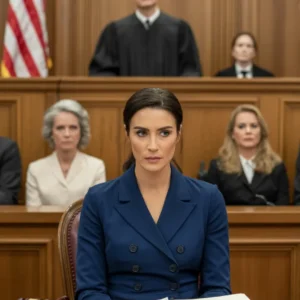
I walked past the hostess stand in my plain navy dress, carrying myself with a kind of careful dignity I had practiced in the mirror before leaving our apartment. The restaurant was in Manhattan, the kind of place with brass fixtures, low amber lamps, and waiters who knew how to move without making a sound. Men in tailored jackets leaned across white tablecloths.
Women with diamond bracelets laughed quietly over glasses of red wine. Outside, yellow cabs slid through the rain-dark streets of New York City. I went to the corner table near the fireplace.
That was the table Curtis had proposed to me at exactly eight years earlier. I had reserved it for our final dinner before the divorce papers were signed the next morning. I wanted closure.
I wanted to look the man I had given my twenties to in the eye and say goodbye with dignity. But dignity, I would learn that night, was the last thing on Curtis Stone’s mind. He arrived twenty minutes late.
He did not hurry. He did not look sorry. He strolled through the dining room wearing the Italian silk suit I had saved six months to buy him for his last birthday.
He looked successful, polished, and completely indifferent to the woman waiting for him at the table where he once promised forever. He pulled out his chair and sat down without a greeting. His eyes stayed glued to his phone.
His thumbs moved quickly across the screen, and a small smirk curved his mouth. I knew exactly who was on the other end of those messages. Tiffany.
His twenty-four-year-old secretary. The one who had called him “Daddy” in the office when she thought no one else could hear. “I ordered the Cabernet you like,” I said, trying to keep my voice steady.“And the filet mignon. Medium rare.”
Curtis finally looked up, but his eyes did not meet mine. He scanned the room first, as if checking whether anyone important might see him sitting with me.
“Yeah, fine,” he said. He picked up the wine glass and took a swallow like it was tap water. “Let’s make this quick, Wendy.
I have plans later.”
“Plans with her?” I asked. His laugh was short and dismissive. “With Tiffany?
Yes. We’re planning the wedding. She wants a winter theme.
It’s going to be spectacular. Much bigger than that backyard barbecue we had when we got married.”
His words landed like small, precise blades. Our wedding had been small because we were broke.
We had folding chairs, paper lanterns, and my best friend Deborah’s husband grilling ribs in the backyard. We had been young, hopeful, and convinced that sacrifice was romantic if it was shared. “That backyard barbecue was all we could afford,” I said quietly, “because I was paying your office rent.”
Curtis leaned back, his mouth twisting.
“And look where that got me.”
For the first time that night, he locked eyes with me. There was no warmth there. No memory.
No softness. Only a cold, hard arrogance that felt almost practiced. “I’m a CEO now, Wendy.
I need a woman who matches that energy. Tiffany is vibrant. She knows what she wants.
She knows how to make a man feel like a king.”
Then he leaned closer. His voice dropped to a cruel whisper. “You’re just tired.
You smell like old cooking oil and laundry detergent. You remind me of the struggle, and frankly, I’m done struggling.”
I gripped the linen napkin in my lap until my knuckles turned white. Eight years.
I had worked double shifts at a diner and taken freelance data-entry jobs at night so Curtis would not have to worry about bills while building his company. I had cooked, cleaned, ironed shirts, soothed his pride after clients rejected him, and carried the silent math of our marriage in my head every day. Now I was just a reminder of the struggle.
“I gave you everything, Curtis,” I said. “I gave up my design degree for you.”
“And that was your choice.” He shrugged and checked his watch. “Don’t play the victim.
You didn’t have the drive anyway. Tiffany has drive. She’s helping me rebrand the entire company image.
She’s the future. You’re history.”
The waiter arrived with our steaks sizzling on hot plates. The smell that once made my mouth water now turned my stomach.
Curtis picked up his knife and fork and started eating as if he had not just cut a human being apart across the table. I stared at the man I had loved. The gray beginning at his temples.
The slight wrinkle between his eyebrows when he chewed. The hands I had held in cheap apartments and hospital waiting rooms and bank lobbies. I knew every inch of him.
But the soul inside him was a stranger. A greedy, shallow stranger. “Once the divorce is final tomorrow,” I said, my voice suddenly calm, “I’m leaving New York.
I’m moving to Oregon.”
He paused with a piece of steak halfway to his mouth. For a second, I thought I saw something pass across his face. Regret, maybe.
Or nostalgia. Then it vanished. “Oregon,” he said.
“To that old shack your grandmother left you in Willow Creek?”
“Yes.”
“Good. Go bury yourself in the woods. It suits you.”
He did not ask how I would survive.
He did not wish me luck. He just chewed and went back to texting. Then his phone rang.
A loud pop song filled the table, bright and cheap against the soft clink of crystal around us. Curtis’s face lit up in a way it had not lit up for me in years. “Hey, babe,” he said, his voice suddenly sweet.
“Yeah, I’m just wrapping up business with the ex. No, it’s boring. I’ll be there in twenty minutes.
Wait for me.”
He hung up, wiped his mouth, and threw the napkin onto his half-eaten steak. Then he stood, buttoning his jacket. “You’re leaving?” I asked.
“We haven’t even finished.”
“I have.” He looked down at me like I was a stain on the carpet. “Tiffany needs me. She’s upset about the flower arrangements.”
He turned to walk away, then stopped.
The waiter had just placed the bill on the table. Curtis picked it up, folded it once, and tossed it onto my plate. It landed in the peppercorn sauce with a soft, humiliating sound.
“You get this,” he said. “Consider it a wedding gift for me and Tiffany. After all, without you paying the bills all those years, I wouldn’t be rich enough to marry her.
So thanks for being the stepping-stone, Wendy.”
Then he walked out. He did not look back once. I sat frozen as the laughter and clinking glasses of the other diners faded into a dull roar.
Heat spread across my face. I looked at the bill stained with sauce, then at the empty chair across from me. I did not cry.
Not yet. Inside the chest of the woman Curtis called tired and hungry, something shifted. It was not a break.
It was a release. The shackles of eight years of ungrateful devotion had just unlocked. “Thank you,” I whispered to the empty air.
“Thank you for showing me exactly who you are.”
I called the waiter over. “Box this up,” I said, pointing to Curtis’s steak. “My dog will love it.
And bring the card machine. I have a new life to start.”
The apartment was silent when I returned. A heavy, suffocating silence pressed against my ears.
The two-bedroom unit in downtown Manhattan was supposed to be our forever home. We had bought it two years earlier, when Curtis’s company finally started turning a real profit. I remembered the day we got the keys.
We had danced in the empty living room to music playing from my phone. I thought we had made it. I thought the hard part was over.
Standing there now, I realized the hard part had been loving a man who saw me as an appliance, useful until a newer model came along. I grabbed a stack of cardboard boxes and started packing. Not everything.
Just my things. The divorce settlement was brutal but simple. Curtis kept the apartment and the company.
I received a small lump sum that barely covered my moving expenses and the credit-card debt I had built up buying groceries, detergent, office supplies, and all the ordinary things a household needs while pretending everything is fine. He had a shark of a lawyer. I had a tired public-defender mentality and one desperate wish: to escape.
I opened the closet. His suits took up three-quarters of the space. My clothes were shoved into a small corner on the left.
I pulled out my dresses, sensible work blouses, and worn jeans. As I reached for a hanger, my hand brushed one of his shirts, a blue Oxford I had bought him for his first big client meeting. Instinctively, I brought it to my nose.
It used to smell like cedar and his cologne. Safety. Now it smelled faintly of a sugary floral perfume.
Her perfume. Tiffany. The scent of betrayal.
I threw the shirt on the floor. Then another. Then another.
Soon a small pile of blue and white cotton lay at my feet. I wanted to burn them. I wanted to scream until the windows shook.
But I did not. I had to be practical. I had a train to catch in forty-eight hours.
I moved to the bedroom dresser and opened the bottom drawer where I kept the things that still mattered. Beneath a stack of winter sweaters sat a battered wooden box made of cherrywood. My grandmother, Nana Rose, had given it to me before she passed five years earlier.
I sat on the floor and ran my fingers over the smooth lid. Nana Rose had been the only person who truly understood me. When I told her I was leaving design school to help Curtis, she did not scold me.
She only looked at me with those sharp blue eyes and said, “Wendy, give your heart, but never give your soul. And never let a man define your worth.”
I had not listened. I had given my soul.
My credit score. My youth. I opened the box.
Inside were old photographs: me at graduation, Nana in her rose garden in Oregon, and a few pictures of Curtis and me from the early days. In those photos, I looked hopeful. Radiant, even.
Curtis looked hungry. I could see it now. He was not looking at me with love.
He was looking at me like a resource. I took the photos of us and ripped them down the middle one by one. Rip.
Rip. Rip. The sound was satisfying in the quiet room.
I tossed the halves with his face into a trash bag. I kept the halves with mine. I needed to remember the girl I used to be.
Also in the box was my old sketchpad. I had not touched it in six years. I flipped through the pages.
Intricate designs for ceramic vases. Interior layouts. Charcoal drawings of the Oregon coastline.
They were good. They were full of life. “You said I didn’t have drive,” I whispered to the ghost of Curtis in the room.
“You were wrong. I used all my drive pushing you up the hill.”
I packed the wooden box, my clothes, and my toiletries. I left the furniture.
I left the expensive espresso machine I had saved for. I left the curtains I had sewn by hand. Those things belonged to the wife of a successful CEO.
They did not belong to Wendy. By three in the morning, the apartment looked strange. It was still full of furniture, but it felt empty because my spirit had already left.
I went to the kitchen and made a cup of tea, standing by the window and looking out at the city lights. New York, the city of dreams, had chewed me up and spit me out. But as I looked at the skyline, I did not feel defeated.
I felt lighter. The weight of trying to be perfect for a man who wanted a trophy was gone. The anxiety of checking bank accounts to see whether we could cover another bill was gone.
The constant feeling that I was not enough had started to fade. I took a sticky note and a pen. I wrote a message and stuck it to the refrigerator beside the calendar where Curtis had marked “wedding tasting” in red ink.
I took my clothes and my dignity. You can keep the rest. You’ll need it to fill the empty space where your conscience should be.
Wendy. I placed the keys on the counter. The metal clicked against the granite.
A final period at the end of a very long, very painful sentence. Then I dragged my two suitcases to the door, turned off the lights, and let darkness swallow the luxury apartment. “Goodbye,” I said softly.
Then I walked out and left the door unlocked. I did not care anymore. The family court building in Lower Manhattan was the kind of place where hope went to die under fluorescent lights.
The air smelled like stale coffee, copier toner, and exhaustion. I sat on a hard wooden bench, smoothing the skirt of my simple beige dress. I wore no makeup.
I wanted to look exactly like what I was: a woman stripping herself of a false identity. Curtis arrived with his lawyer, a sharp-featured man in a suit that cost more than Nana Rose’s entire kitchen renovation. Curtis looked tired.
Dark circles sat under his eyes, and no amount of expensive skincare could hide them. Was Tiffany keeping him up? Was guilt eating him?
No. Curtis did not do guilt. He was probably stressed about wedding logistics.
He sat at the table opposite me and did not acknowledge me. He checked his phone every thirty seconds, tapping one polished shoe against the floor. “All rise,” the bailiff droned.
The proceedings were a blur of legal phrases. Irreconcilable differences. Mutual consent.
Waiver of spousal support. That last part was the bitterest pill. Curtis’s lawyer had threatened to drag the divorce out for years if I asked for alimony, draining what little money I had left.
I had chosen freedom over money. I just wanted out. “Do you, Wendy Miller, agree to these terms?” the judge asked, peering over her glasses.
I looked at Curtis. He was staring at the clock. “Yes, Your Honor,” I said.
“I agree.”
“And you, Mr. Stone?”
“Yes. Yes, I agree,” Curtis said quickly.
“Can we finalize this now?”
The judge frowned at his impatience but stamped the papers. “Decree granted. You are no longer husband and wife.”
The gavel came down.
It was over. Eight years dissolved in fifteen minutes. I walked out of the courtroom with a strange mix of hollowness and elation.
I was free. Then I saw Curtis practically sprint toward the elevator. His phone was already at his ear.
“It’s done, babe,” he said. “Yeah, I’m coming to pick you up for the ultrasound. Don’t worry.”
He disappeared into the elevator.
“That man is unbelievable.”
The voice beside me was Deborah’s. I turned and found my best friend standing there with two large coffees and the kind of furious expression that made strangers move out of her way. Deborah was everything I was not: loud, brash, fearless, and fiercely protective.
“Deborah,” I sighed, taking the coffee. “It’s over. Let him run.”
“You don’t get it, do you?” She steered me toward a quiet corner.
“You didn’t hear what he said.”
“I heard him.”
“Ultrasound, Wendy.”
The word echoed in my head. Ultrasound. Deborah lowered her voice.
“My cousin works at the reception desk at Dr. Peterson’s OB-GYN clinic uptown. She saw Curtis and Tiffany come in last week.
Tiffany is pregnant.”
The hallway tilted. “How far along?”
“Three months.”
Three months. That meant they had been reckless, or planning, while I was still washing his shirts and cooking his dinners.
I leaned against the cold wall. “That’s why he rushed everything,” Deborah said. “That’s why he bullied you into a quick settlement with no alimony.
He needed you gone so he could play the respectable family man before she started showing.”
I closed my eyes. I thought I had reached the bottom of the pain, but there was a basement. He had not only replaced me.
He had started a family behind my back. A family I had wanted with him. He had always said, “Not yet.
The company comes first.”
“It was never about timing,” I said, and a bitter laugh slipped out. “It was about the woman.”
“Wendy.” Deborah grabbed my shoulders. “Listen to me.
You were the workhorse. She’s the show pony. But show ponies are expensive.
And Curtis’s company is shakier than he wants people to know. He is leveraging everything to keep up that image.”
“It doesn’t matter,” I said. “Let him drown.
I’m going to Oregon.”
Deborah softened and pulled me into a hard hug. “You go to Oregon. You heal.
You plant that garden. But mark my words, karma has a GPS, and it knows exactly where Curtis lives.”
“He thinks he won,” I whispered. “One man’s trash is another man’s treasure,” Deborah said.
“Or in this case, one man’s trash is a diamond he was too stupid to polish.”
I walked out of the courthouse into the blinding midday sun. Yes, the pregnancy burned. But it also cauterized the wound.
There was no what-if left. No maybe. No fantasy that we could have worked things out.
There was only the truth. I hailed a taxi. “Penn Station, please.”
As the cab merged into traffic, I took my phone from my purse.
I opened my contacts, found “Husband,” changed it in my mind to Curtis, and deleted it. Then I removed the SIM card, snapped it in half, and tossed the pieces out the window onto Eighth Avenue. “Goodbye, New York,” I whispered.
Then, after a moment, I added, “And good luck, Tiffany. You’re going to need it.”
The Amtrak train clicked rhythmically beneath me, a metallic lullaby that softened the chaos in my head. Clack, clack.
Whoosh. Clack, clack. I stared out the window for hours while the concrete sprawl of the East Coast gave way to the wide fields of the Midwest and, later, the rising shadows of the West.
I had booked a sleeper car. It was an extravagance I could barely justify, but I needed privacy. I could not sit in coach shoulder-to-shoulder with strangers and pretend I was not fleeing the wreckage of my life.
On the second day, the landscape outside felt endless. Empty, but spacious. It matched something opening inside me.
I pulled Nana Rose’s battered copy of Pride and Prejudice from my bag, but I could not focus. My mind kept returning to Curtis throwing the restaurant bill at me. The contempt on his face.
How does love turn into that? How does “I do” become “you get this”? I went to the dining car for coffee.
Across the aisle sat an older woman, perhaps in her seventies, with a silver bob and bright, observant eyes. She was knitting something that looked like a colorful storm. She caught me looking and smiled.
“It’s a scarf,” she said. “Or a blanket. It hasn’t decided yet.
I’m just letting it happen.”
For the first time in days, I smiled for real. “That sounds like a good philosophy.”
“I’m Martha.” She studied me over the rim of her glasses. “You look like you’re either running away from something or running toward something.
Which is it?”
I hesitated. Normally, I did not tell strangers my pain. But I had no SIM card, no husband, no home, and no reason to protect Curtis anymore.
“Running away,” I admitted. “My husband—ex-husband—traded me in for a newer model and a baby.”
Martha stopped knitting. “Ah,” she said.
“The midlife-crisis upgrade. Painful, but classic.”
“He said I was tired. He said I smelled like struggle.
I worked two jobs to build his company, and now he’s marrying his secretary and living the life I paid for.”
Martha nodded and resumed knitting. “Honey, listen to me. Men like that are like parasites.
They attach, they drain, and when the host is dry, they move on. But here is the part they forget. Once the parasite is gone, the host recovers.
The parasite has to find someone else before it starves.”
“He found someone,” I said. “She’s twenty-four.”
“She is not a victim yet,” Martha replied. “She is the next meal.
Give it time.”
Then she leaned forward. “Where are you going?”
“Oregon. Willow Creek.
My grandmother left me an old stone house there. I haven’t been back in years.”
“Oregon.” Martha sighed dreamily. “Big trees, clean air, good soil.
That is a place to grow roots, not just park a car. You take that house and make it yours. Strip the wallpaper.
Paint the walls a color you like, not a color he would approve of. Reclaim your space.”
“I’m scared,” I confessed. “I’m thirty-two.
I have no job, no husband, and barely any money. I feel like I failed.”
Martha laughed, sharp and warm at the same time. “Failed?
You survived. You did not fail. You escaped.
You think winning is staying with a man who disrespects you? That is losing, dear. Walking away with your head high is the victory.”
She reached into her bag and pulled out a wrapped chocolate.
She slid it across the table. “Eat this. Chocolate helps.
And remember, sometimes the train has to go through a long dark tunnel before it hits the coast. You are in the tunnel right now, but the ocean is waiting.”
I ate the chocolate. It was dark and bittersweet.
That night, the train whistled through the mountains, and I lay in my narrow bunk watching the moon race beside the window. Martha’s words echoed in my mind. You did not fail.
You escaped. For the first time, I imagined the future not as a terrifying void but as a blank canvas. The next morning, pine trees crowded the hills.
The air coming through the vents felt cooler, cleaner. The conductor’s voice crackled over the intercom. “Next stop, Willow Creek.
Willow Creek coming up.”
I gathered my bags and checked my reflection in the small mirror. I looked tired and pale, but my eyes were clear. The resignation was gone.
When the train hissed to a stop, I stepped onto the platform. The air hit me immediately. Damp earth.
Pine needles. Rain. It was clean.
It did not smell like betrayal. I dragged my suitcases to the edge of the platform and looked out at the small Oregon town nestled in the valley. It looked like a painting.
“I’m home, Nana,” I whispered to the wind. “I’m finally home.”
A taxi driver named Pete, wearing a thick flannel shirt and talking as if silence offended him, dropped me at the end of the long gravel driveway. “Ain’t nobody lived at the Rose place for a long time,” he said, looking at the ivy climbing the stone walls.
“Shame. Used to be the prettiest garden in the county.”
“It will be again,” I said, handing him cash. It was a promise to myself.
The house stood before me, a sturdy two-story cottage made of gray river stone, with a slate roof and a wide wooden porch. It looked like a fairy tale paused mid-sentence. Weeds choked the rosebushes.
Blue paint peeled from the shutters. One shutter hung crookedly and tapped softly in the breeze. But it was mine.
The only thing in the world that was truly mine. I found the spare key where Nana had always kept it, under the third terracotta pot to the left of the door. The lock was stiff, but after a hard jiggle, the oak door creaked open.
Dust motes floated through beams of sunlight. The air smelled musty, with a faint trace of Nana’s lavender potpourri. Furniture sat covered in white sheets like ghosts waiting for a party.
I pulled the sheet off Nana’s favorite wingback chair by the fireplace. Dust puffed into the air, and I coughed. “Okay,” I said aloud.
“First things first. Windows.”
I spent three hours opening every window, letting the Oregon breeze sweep out five years of stillness. I swept floors, wiped kitchen counters, and made up the bed in the guest room.
I could not bring myself to sleep in Nana’s room yet. By evening, my muscles ached. It was a good ache.
The ache of accomplishment. I sat at the kitchen table with instant tea and looked around. I remembered baking cookies there with Nana.
I remembered crying at that table over a boy in high school while Nana told me, “Boys are like buses, Wendy. Another one comes every fifteen minutes. But your education—that is yours forever.”
I had disappointed her by dropping out.
The guilt pricked at me. Then I noticed a stack of mail on the counter. The property management company I had hired had done bare-minimum checks over the years and left everything in tidy piles.
Most of it was junk mail and old bills set to autopay. At the bottom was a thick cream envelope. It had no postmark.
My name, Wendy Miller, was written across the front in elegant cursive ink. I recognized the handwriting. It was not Nana’s.
It belonged to Mr. Higgins, her old lawyer and lifelong friend. I tore it open.
Inside was a letter dated five years earlier, the week Nana died. Dear Wendy,
If you are reading this, two things have happened. First, I have passed on.
Second, you have finally returned to Willow Creek alone. My hands began to tremble. How had she known?
I know you loved that boy, Curtis. But I have lived eighty years, my dear, and I know a wolf when I see one. He has hungry eyes, but not for you.
For what you can give him. I wanted to leave you everything immediately. But I knew if I did, he would take it.
He would use it to build his dreams and leave you with nothing. So I created a safety net. A test of time.
Enclosed is the contact information for Mr. Higgins. Go see him immediately.
There is a trust fund in your name. The condition is strict. You cannot access a single cent until you turn forty, or until you provide proof of divorce or a death certificate of your spouse.
I prayed you would prove me wrong and have a happy marriage. But if you are reading this, I was right. And if I was right, you are going to need resources to rebuild.
Do not be afraid. You are stronger than you think. And now you will be freer than you ever imagined.
Love,
Nana Rose. I stared at the letter until tears blurred the ink. She knew.
She had seen through Curtis’s charm, through the ambition and polished words. She had locked away my inheritance to protect it from him. At the bottom of the letter was the number for Higgins and Associates.
It was 5:30 p.m. The office was closed. I barely slept that night.
The countryside was quiet, filled with owls and wind in the trees, but my mind was loud. What had Nana left me? Enough to fix the roof?
Enough to start over? Whatever it was, it was safe. Curtis had not touched it.
He did not even know it existed. For the first time in eight years, I had a secret. And it felt powerful.
Higgins and Associates sat on the town square between a bakery and a hardware store. It looked exactly as it had when I was a child: brick facade, gold lettering on the glass, and a bell that jingled when I pushed the door open. Mr.
Higgins sat behind a massive oak desk that seemed to swallow the room. He was a small man with tufts of white hair and wire-rimmed glasses, looking very much like a wise owl. When he saw me, his face softened.
“Wendy,” he said, rising to shake my hand. “I have been waiting for you.”
“News travels fast,” I said nervously. “In Willow Creek, news travels faster than light.” He smiled, then turned serious.
“I assume you found the letter.”
I nodded and pulled the divorce decree from my bag. The same paper I had received in a sterile New York courtroom three days earlier. I placed it on his desk.
“Nana said I needed this.”
Mr. Higgins adjusted his glasses and examined it carefully. “Signed, sealed, and finalized.
I am sorry for your pain, Wendy. But I am glad for your timing.”
He opened a drawer and withdrew a thick leather binder. “Your grandmother was a remarkable woman.
Most people knew her as the lady with prize-winning roses. Very few knew she was one of the shrewdest investors on the West Coast.”
My jaw loosened. “Nana invested?”
“Since the seventies.
She bought land when it was cheap. She bought technology stocks when people thought computers were a passing curiosity. She lived simply because she liked simple things, not because she had to.”
He opened the binder and turned it toward me.
“This is the Rose Miller Trust. As of this morning’s market opening, the total value of the assets—including the house, diversified stock portfolio, and cash reserves—is here.”
He pointed to a figure at the bottom of the page. I looked.
I blinked. Then I looked again. $5,240,000.
The air left my lungs. “Five million dollars,” I whispered. “This has to be a mistake.”
“Nana sold jam at the county fair,” Mr.
Higgins said gently, “and put every dollar of profit into Berkshire Hathaway.”
I covered my mouth. “It is all yours, Wendy. The conditions of the trust have been met.
You are divorced. The wolf is gone from the door. The assets are fully under your control.”
For eight years, I had clipped coupons.
I had walked twenty blocks to save bus fare. I had let Curtis lecture me for buying the expensive coffee. I had lived in constant financial anxiety, feeling like a burden, a beggar inside my own marriage.
And all that time, I had been a millionaire. “Does Curtis know?” I asked. “Absolutely not,” Mr.
Higgins said. “The trust was structured specifically to remain invisible. Since your access was triggered after the divorce was finalized, it is not marital property.
He has no claim to a single cent. It is yours. Clean and clear.”
A laugh bubbled up in my throat.
It began as a small sound and grew until tears streamed down my face. It was hysterical, liberating, and slightly unhinged. “Are you all right?” Mr.
Higgins asked, sliding over a box of tissues. “I’m fine,” I said, wiping my eyes. “I’m just thinking about how he left me because he thought I was poor.
He threw a restaurant bill at me, Mr. Higgins. He told me to pay it.”
Mr.
Higgins leaned back. “Now you could buy the restaurant if you wanted.”
“No,” I said, sitting straighter. “I don’t want a restaurant.
And I don’t want anyone to know about this. Not yet.”
“Discretion is wise,” he said. “In a small town, money attracts flies.”
“I want to live in Nana’s house.
I want to fix it myself. I want to get a job. I want a normal, quiet life.
I need to heal, Mr. Higgins. Money can buy comfort, but it can’t do the work for me.”
He nodded approvingly.
“A mature decision. We can set up a monthly allowance from the interest so you live comfortably but not flashily. The principal will continue to grow.”
I shook his hand when I left.
I had walked into that office as Wendy the divorced failure. I walked out as Wendy the heir. But more importantly, I walked out as Wendy the survivor.
The sun shone over the town square. I caught my reflection in the bakery window: jeans, T-shirt, messy bun. I looked the same.
But I knew the truth. I was everything Curtis had wanted to be. And he had thrown me away.
I walked into the hardware store next door. I needed paint. Gardening tools.
And I bought the expensive gloves because I could. The next few months were the most peaceful of my life. I did not touch the millions beyond the modest allowance Mr.
Higgins arranged, which was still more than I had ever been allowed to spend without Curtis questioning me. I threw myself into restoring the house. I scraped away layers of ugly wallpaper and found beautiful vintage plaster underneath.
I sanded the floors until my arms ached and the wood gleamed like honey. I pruned the rosebushes, cutting out dead wood so new buds could breathe. The metaphor was not lost on me.
I also needed to leave the house sometimes. I did not want to become a ghost in Nana’s rooms. One afternoon, I walked into Clay and Fire, the local pottery studio.
I had spent so much of my youth in studios like it before Curtis convinced me that art was an indulgence for people who did not understand bills. The owner, Sarah, a cheerful woman with clay permanently under her fingernails, hired me after watching me throw a vase. “You have the touch,” she said.
“You center the clay perfectly. Most people fight it. You move with it.”
“I learned the hard way,” I said.
“Fighting gets you nowhere.”
Teaching beginner wheel classes gave me purpose. I met the women of Willow Creek: mothers needing a break, retirees looking for a hobby, teenagers who wanted somewhere safe to be after school. We got messy.
We drank tea. We laughed. I was not Curtis’s ex-wife there.
I was Wendy, the pottery teacher who made beautiful vases. One Tuesday afternoon, a booming voice filled the studio. “I heard there’s a new teacher here.
Is she any good, or is she just playing with mud?”
I turned and saw a large man with a white beard and a cowboy hat standing in the doorway. He looked like Santa Claus after a long ride through the country. “Uncle Roy?”
Roy was not my real uncle.
He had been an old business partner of Curtis’s father, but he had always been the black sheep of that circle because he was honest, loud, and allergic to pretension. He had moved to Oregon years earlier to retire on a ranch. I had not seen him in nearly a decade.
“Little Wendy!”
He rushed over and wrapped me in a bear hug that smelled faintly of tobacco, leather, and horses. “My God, look at you. What are you doing here?”
“I live here now,” I said.
“I took over Nana Rose’s house.”
“And Curtis? Where is that stiff-necked husband of yours?”
My smile faltered. “We’re divorced, Uncle Roy.
He found someone else.”
Roy’s face darkened. “That little weasel. I never liked him.
Always walked like he had a stick where sunshine never reaches.”
I laughed despite myself. “He traded me in for his secretary. She’s twenty-four and supposedly pregnant.”
Roy muttered under his breath, then glanced at Sarah.
“Sorry, ma’am.”
Sarah only raised an eyebrow and went back to wedging clay. “He’s an idiot,” Roy said. “Always was.
Just like his father, chasing glitter and missing the gold.”
Roy became a regular part of my life after that. He came by the house to help with heavy jobs: porch steps, gutters, a stubborn window frame that had swollen from years of rain. We sat on the porch drinking iced tea while he told stories about the old New York business crowd and how half of them were fake all the way down to their cuff links.
I did not tell him about the money. I did not tell anyone. I wanted him to like me for me, not for a checkbook.
And he did. He treated me like a daughter. “You seem happy, kid,” he said one evening, watching the sun fall over my blooming rose garden.
“I am,” I said, and realized it was true. “I don’t have much.”
That was a lie, but a necessary one. “But I have peace.”
“Peace is expensive,” Roy said.
“Most rich folks I know can’t afford it. Curtis, for example. I hear through the grapevine that he’s sweating bullets.”
“Oh?” I tried to sound casual.
“My old contacts say he’s leveraged to the roof beams for this wedding. Trying to impress people who don’t care. He’s building a castle on quicksand.”
I took a sip of tea to hide my smile.
“Well,” I said, “I hope he knows how to swim.”
Life in Willow Creek stitched my soul back together. I stopped checking my phone for updates. I stopped having nightmares about Curtis.
I was rebuilding my foundation brick by brick. Unlike Curtis’s castle, mine was solid stone. But as Nana’s letter said, the wolf had hungry eyes.
And even though I was safe, the wolf was out there getting desperate. The bubble of peace did not burst, exactly. It was pierced by a ringtone.
It was Deborah. “Grab popcorn,” she said the moment I answered. “I have tea, and it is scalding hot.”
I wiped clay off my hands and sat on a studio stool.
“What happened?”
“Remember how Curtis was always obsessed with image?”
“Hard to forget.”
“Well, he’s trying to land a contract with the Tanaka Group. Big Japanese investors. Apparently, this contract is the only thing keeping his company from sinking.
He’s been bleeding cash since you left.”
“Since I left? I wasn’t the CFO. I just managed the household.”
“Exactly,” Deborah said.
“You managed the household on a shoestring so he could reinvest. You managed his stress so he could focus. Without you, he’s hiring consultants for everything, eating out every night, and Tiffany is spending company money on office décor that somehow looks like nursery furniture.”
“So he’s broke.”
“Worse.
He’s in the red but spending like he’s in the black to impress Mr. Tanaka. He invited the investors to the wedding.
He wants to prove he’s a stable, wealthy family man. So the wedding has to look like the event of the century.”
Deborah took a breath. “They rented the grand ballroom at the Plaza.
Hired a string orchestra. And Tiffany ordered a custom dress from Paris. Twenty-five thousand dollars.”
I nearly dropped my phone.
“Does Curtis even have that?”
“No. That’s the best part. His credit cards are maxed out.
He’s taking desperate short-term loans. He’s gambling everything on that Tanaka deal going through after the wedding.”
“He is going to crash.”
“He’s already in the air,” Deborah said. “Tiffany is driving the train off the cliff.
She threw a fit because the diamonds on her tiara weren’t big enough. She thinks she’s marrying a billionaire, and Curtis is too terrified of losing face to tell her he’s broke.”
I looked around my quiet pottery studio. At the vase I had just made.
Simple. Imperfect. Real.
The contrast was staggering. Curtis was drowning in debt and lies, wearing a tuxedo to hide the panic. I was wearing a clay-covered apron, sitting on a fortune, and had never felt richer.
“There’s more,” Deborah said. “I got an invite.”
“What? Why?”
“Because Dave is still technically one of Curtis’s clients.
Curtis needs bodies in the room to make it look full. He thinks I’m dumb enough to show up with a gift.”
“Are you going?”
“Are you kidding? I wouldn’t miss this train wreck for the world.
I’m going to drink his expensive champagne and stream the disaster to you. You need to see what you escaped.”
“I don’t know.”
“You do. You need closure.
You need to see him sweating in that tight suit while his fake world crumbles. It’s therapeutic.”
Then her voice sharpened with delight. “Oh, and guess who else is invited?”
“Who?”
“Uncle Roy.”
“Roy?
He’s here in Oregon.”
“Curtis invited him. Probably because Roy knows the Tanaka people. He’s using everyone, Wendy.
He wants Roy to network for him.”
I smiled slowly. Uncle Roy. The man who called Curtis a weasel.
The man who knew I was happy but did not know I was rich. And most importantly, the man who could not keep a secret after two whiskeys. “If Roy goes,” I said, “it’s going to be interesting.”
That night, I invited Uncle Roy over for dinner.
I made roast chicken and opened a bottle of wine. “So,” I said casually, “I heard you got an invite to a fancy wedding in New York.”
Roy groaned. “That weasel Curtis.
I tossed it in the trash.”
“You should go.”
“Why? I hate the guy.”
“Because he’s trying to impress a Japanese investor. And you know people.
You could observe.”
Roy narrowed his eyes. “And?”
“And I think it would be funny.”
His eyes twinkled. Then he laughed, a deep belly sound that shook the room.
“You’re up to something, little Wendy.”
“Maybe.”
“You know what? Fine. I haven’t seen a good train wreck in years.
And I owe his daddy a favor. Maybe stopping Curtis from ruining the family name is that favor.”
“Promise me one thing,” I said. “Don’t tell him where I live.
Don’t tell him anything private. Just tell him I’m doing great.”
“I’ll tell him you’re the Queen of Sheba if you want.” Roy winked. “I’ll book the ticket tomorrow.”
I went to bed that night feeling a strange electricity in the air.
The stage was set. The actors were taking their places. Curtis was stacking lie upon lie, building a house of cards high enough for everyone to admire.
And Uncle Roy was blowing into New York like a hurricane. I did not know exactly what would happen. I did not know the secret I had kept from Roy would come out.
But I knew one thing. Curtis Stone was about to have the worst wedding day of his life, and I would have a front-row seat from three thousand miles away. The week before the wedding, the air in my pottery studio felt charged, like the sky before a storm.
I was glazing mugs when Deborah called. She did not say hello. “Sit down, Wendy.
Put the clay down. You need to be sitting.”
I wiped my hands on my apron and pulled up a stool. “Deborah, you’re scaring me.
Did Curtis hurt someone?”
“No. But he’s being played. And I mean played like a cheap fiddle.”
“By Tiffany?”
“Remember the pregnancy?
The three-month miracle baby that forced the quick divorce?”
“Yes,” I said dryly. “The reason I’m in Oregon.”
“It’s fake.”
Silence swallowed the studio. “What do you mean fake?
You said your cousin saw them at the clinic.”
“My cousin saw them in the waiting room. But listen. I have a friend who works in high-end retail.
Tiffany went in yesterday for a final fitting of her reception dress. My friend was helping her change.”
Deborah paused for dramatic effect. “And?” I pressed.
“When Tiffany undressed, there was no bump. Flat. Then she pulled a silicone prosthetic from her bag.
A strap-on belly. She put it on before the dress went back on.”
A wave of nausea moved through me, followed by cold horror. A fake pregnancy.
It sounded like something from a bad daytime soap, not real life. “She’s trapping him,” I whispered. “She knows he’s desperate for an heir and desperate to look like a family man for the Tanaka deal.
She used a piece of silicone to secure a ring.”
“Exactly,” Deborah said. “And my friend heard her talking on the phone in the dressing room. Tiffany said that once the ring is on and the papers are signed, she’ll claim she lost the baby.
He’ll be too devastated to leave.”
My blood chilled. To invent a child and then plan its disappearance as emotional leverage was a kind of cruelty I could barely comprehend. Even though I despised Curtis, the idea of him grieving a baby who had never existed made me sick.
“He doesn’t know?”
“No clue. He’s too busy drowning in debt to notice his fiancée’s belly comes from a bag.”
I walked to the window and looked out at peaceful Willow Creek. It felt like another universe.
In New York, Curtis was walking into a trap set by someone even hungrier than he was. “What are you going to do?” Deborah asked. “Are you going to tell him?”
I thought about the restaurant bill.
I thought about him calling me tired. I thought about eight years of my life poured into a man who treated me like old furniture. “No,” I said.
“He wanted a shark. He got one. Let’s see if he knows how to swim.”
“That’s my girl,” Deborah said.
When I hung up, I looked down at the unfinished mugs. I picked up a carving tool and cut a deep line into the clay. I was not vindictive by nature.
Nana Rose had raised me to be kind. But she had also raised me to respect consequences. Curtis had built his house on lies.
It was only fitting that the woman he chose was the biggest lie of all. That night, I could not sleep. I kept imagining the wedding vows.
For richer or poorer. They were both lying about the richer part. They were both secretly poorer.
It was a marriage of two bankruptcies pretending to be a merger. I walked into the garden in my pajamas beneath a full Oregon moon. The roses glowed silver.
I touched a thorny stem. “You reap what you sow, Curtis,” I whispered. “You reap what you sow.”
Saturday arrived gray and rainy in Oregon.
On my laptop screen, however, New York glittered. Deborah had positioned her phone discreetly near a centerpiece, giving me a wide-angle view of the grand ballroom at the Plaza Hotel. I sat in my living room wrapped in a knitted blanket, tea in one hand and a bowl of popcorn in the other.
It felt surreal. I was watching the funeral of my past life. The venue was obscenely lavish.
Crystal chandeliers the size of small cars hung from the ceiling. White roses covered every surface, making the room feel less like a wedding and more like a floral takeover. Ice swans guarded the buffet.
A ten-piece string orchestra played Vivaldi. Deborah texted me. It smells like money and desperation in here.
The shrimp are cold, but the champagne is flowing. I scanned the guests. I saw old acquaintances, people who used to come to our apartment for cheap potlucks when we were broke.
They looked uncomfortable in rented tuxedos. I saw the Tanaka group, five serious Japanese businessmen in impeccable suits, seated near the front, observing everything with polite detachment. Then the music swelled.
Curtis entered first. My breath caught. From a distance, he was handsome in his tailored tuxedo.
But when Deborah zoomed slightly, I saw the truth. His forehead shone with sweat. His smile was tight, almost painful.
His eyes darted around the room with panic, not joy. He looked like a man waiting for a bomb to go off. Then came Tiffany.
She was a vision of excess. Her dress was a massive cloud of tulle, lace, and crystals that caught the light aggressively. Her tiara looked heavy enough to damage her posture.
Beneath the fitted bodice was the bump, a perfect rounded curve she cradled with one hand as she walked. “Performance of a lifetime,” I muttered. She reached the altar.
Curtis took her hand and flinched slightly, as if her touch burned. The ceremony was a blur of hollow vows. They kissed with a showy Hollywood kiss meant for cameras, not hearts.
The guests applauded politely. The Tanaka men clapped exactly three times each. Then came the reception.
That was where the real show began. Deborah shifted her phone to follow the head table, which was elevated like a royal platform. Curtis and Tiffany sat above the room, looking down on everyone they needed to impress.
I saw Curtis lean toward Tiffany and whisper something sharp. She whispered back with a frozen smile for the photographer. Deborah texted again.
I walked by the head table. Curtis told her to stop ordering vintage wine because the tab is maxed out. She told him to shut up and smile for the investors.
I shook my head. They were trapped in a cage they had built together. Then the camera panned toward the table beside the Tanaka group, and my heart skipped.
There was Uncle Roy. He wore a tuxedo that was clearly twenty years old and one size too small. His bow tie was crooked.
In front of him sat three empty whiskey glasses. “Oh no,” I whispered. “Roy, please don’t be drunk.”
But he was.
He was laughing loudly at something the man next to him said. That man was Mr. Henderson, a vice president at the bank that held Curtis’s mortgage and, most likely, several of his business loans.
It was a recipe for disaster. Uncle Roy, the loose cannon. Mr.
Henderson, the man holding the debt. Curtis, the fraud, sitting ten feet away. The speeches began.
The best man, a slick man named Brad whom I had never liked, tapped the microphone. “Ladies and gentlemen, to the happy couple.”
Roy did not stand for the toast. He leaned toward Mr.
Henderson instead. I could not hear him at first, but I saw him gesturing with one hand. Then he pointed across the room, perhaps at Deborah’s phone, perhaps at the invisible idea of me.
My stomach tightened. I had told Roy to keep quiet. But Roy had whiskey in him and a deep, abiding hatred for Curtis.
“Please, Roy,” I begged the screen. “Eat your cake and stay quiet.”
Chaos, apparently, had RSVP’d. As the speeches dragged on, Curtis looked ready to faint.
He kept glancing at the investors, needing this night to look perfect, needing to appear like the master of his universe. Deborah’s phone was close enough now that I could hear Roy clearly during a lull. “Boring,” he stage-whispered.
“This fellow talks more than a politician.”
A few people shushed him. Mr. Henderson looked uncomfortable and tried to face forward.
Roy leaned heavily against his shoulder. “You know, I just got back from Oregon. Beautiful country.
Real country. Not like this plastic city.”
“That’s nice, sir,” Henderson said politely. “Visited an old friend’s granddaughter,” Roy continued, voice booming now.
“Little Wendy. You know Wendy? The groom’s ex-wife.”
At the head table, Curtis stiffened.
His head snapped toward Roy. Tiffany rolled her eyes, visibly annoyed that an ex-wife had entered her spotlight. “I believe I met her once,” Mr.
Henderson said, trying to lower the volume. “Great girl!” Roy shouted. “Salt of the earth and smart.
Smarter than this idiot.”
He jerked a thumb toward Curtis. The room went quiet. The best man stopped talking.
All eyes turned to the red-faced old man in the tight tuxedo. “Roy,” Curtis said, standing with a forced laugh. “Let’s not bore everyone with ancient history.
We’re here to celebrate the future.”
“The future?” Roy scoffed, rising unsteadily. “What future? The one you built on credit?”
A gasp moved through the ballroom.
The Japanese investors exchanged glances. “Sit down, Roy,” Curtis hissed. “I’m not causing trouble.” Roy raised his hands.
“I’m just telling my friend here about Wendy. You know, the woman you tossed out like garbage? Turns out garbage can be gold.”
My heart hammered.
“Roy,” I whispered. “Don’t.”
“I saw her,” Roy announced. “She’s living in Willow Creek.
Got a garden full of roses. And she looks happy. Real happy.
Not like you sweating through that cheap-looking suit.”
“I am calling security,” Tiffany snapped. “Get this drunk old man out of here.”
“Wait,” Roy yelled. “I just want to tell Mr.
Banker here the best part. You know Wendy’s grandmother, old Nana Rose? Everybody thought she was just a gardener.”
He slapped the table.
The sound cracked through the ballroom. “Turns out Nana Rose was a genius. She left Wendy a little present.
A trust fund.”
Curtis froze. The anger on his face turned to sharp confusion. “What trust fund?
Wendy didn’t have a dime.”
“That’s what you thought,” Roy said. “That’s what everybody thought. But I saw the papers.
I saw the house. Wendy is sitting on a mountain, boy.”
I buried my face in my hands. He was doing it.
He was spilling everything. “How much?” someone whispered. Human nature did what human nature always does.
Everyone wanted the number. Roy grinned and held up five fingers. “Five hundred thousand?” Curtis asked, a sneer trying to return.
“That’s cute.”
“No, you fool,” Roy roared. “Five million dollars.”
The silence that followed was absolute. It was not merely quiet.
It was a vacuum. The air had been sucked out of the room. “Five million,” Roy repeated.
“Cash and assets. All hers. And you know the kicker?
She got access to it the day you divorced her. If you had stayed married, you might have seen a penny. But you dumped her, so she got it all.”
I watched Curtis.
I watched the color drain from his face, starting at his neck and moving upward until he looked like wax. His mouth opened. No sound came out.
Five million dollars. It was more money than his company had ever made. Enough to save him ten times over.
And he had walked away from it to marry a secretary with a fake belly and a taste for expensive flowers. “You’re lying,” Curtis whispered. “Wendy is broke.
She worked at a diner.”
“She worked at a diner to feed you,” Roy shouted. “Now she’s the richest woman in Willow Creek.”
Tiffany stood, furious. “Don’t you dare talk about me like that.
I am worth ten of her.”
But Curtis was not looking at Tiffany anymore. He was staring into space, his mind doing the math. The terrible math of his own stupidity.
“Five million,” he mouthed. He looked ill. Like a man who had sold a winning lottery ticket for one dollar.
But the show was not over. Mr. Henderson, the banker, was looking at Curtis with a very strange expression.
He stood slowly, adjusting his glasses. “Mr. Stone,” Henderson said, his voice cutting through the murmurs.
“Is this true? Did you divorce a multimillionaire?”
“It doesn’t matter,” Curtis snapped, trying to regain control. “That’s her money.
I have my own company. I have this deal.”
He looked desperately at the Tanaka group. “About that,” Henderson said, pulling a file from inside his jacket, “since we are sharing truths tonight…”
I leaned closer to the screen.
The second wave was coming. Mr. Henderson was not a cruel man.
I remembered him from our mortgage application years ago. He was serious, by-the-book, and utterly without humor. That made what happened next even more devastating.
“Mr. Stone,” he said, projecting clearly, “you asked the bank yesterday for an emergency extension on your business loan. You claimed you had significant personal assets coming into the marriage.”
Curtis’s face tightened.
“This is not the place, Henderson.”
“A wedding you paid for with a check that bounced this morning is, unfortunately, now a financial matter.”
Gasps erupted. The Japanese investors whispered among themselves. One of them began gathering his papers.
“It was a clerical error,” Curtis stammered. “I’ll transfer funds on Monday.”
“There are no funds to transfer,” Henderson said. “We audited your accounts.
You are overdrawn by four hundred thousand dollars. Your company is insolvent.”
Tiffany let out a strangled sound and grabbed Curtis’s arm. “What is he talking about?
You said you were rich. You said the company was booming.”
“Not now, Tiffany,” Curtis snapped, shaking her off. “And speaking of assets,” Henderson continued, turning toward Tiffany with visible distaste, “Mrs.
Stone came to my branch last week. She made quite a scene after your credit card was declined at the flower shop.”
Tiffany froze. “She shouted,” Henderson said, “‘I can’t believe I have to lend this man five thousand dollars of my own money just to pay for centerpieces.
I thought I was marrying a CEO, not a charity case.’”
The room erupted. Laughter. Shock.
Whispers. “You called me a charity case?” Curtis turned on Tiffany, his eyes bulging. “Well, you are,” Tiffany shrieked.
“You’re broke. You made me pay for flowers. You made me pay for the DJ.
You told me it was temporary. You told me you had millions.”
“I would have had millions if I hadn’t met you,” Curtis shouted, gesturing toward the empty air as if my lost fortune were standing beside him. “So you lied to me?” Tiffany screamed.
“You tricked me. I wasted my youth on you.”
“Your youth?” Curtis laughed, high and frantic. “You’re twenty-four.
You’ve known me six months.”
The head of the Tanaka delegation stood. He looked at Curtis with icy calm. “We do not do business with clowns.”
The deal was off.
The delegation stood as one and walked out. “No. Wait.” Curtis stumbled after them and caught his foot in Tiffany’s train, dropping awkwardly to one knee.
“Mr. Tanaka, please. It’s a misunderstanding.
I have the capital.”
“You have nothing,” Henderson said, closing his file. “The bank will begin foreclosure proceedings on your apartment Monday. Enjoy your cake, Mr.
Stone. It may be the last luxury you see for a while.”
Curtis knelt on the ballroom floor, watching the investors leave. His dream was dead.
His company was dead. His reputation was burning in real time. At Uncle Roy’s table, Roy lifted his glass.
“Best wedding ever. Waiter, more whiskey.”
But I was not laughing. I watched Curtis’s face.
The arrogance had disappeared. In its place was a hollow terror. He looked toward Deborah’s phone as if he could feel me watching.
In that moment, I think he knew. He knew I had seen it all. He stood slowly, shaking.
Tiffany was crying now, not from sadness, but from rage. She was tapping at her phone, probably calculating whether she could return the dress. “You did this,” Curtis said, pointing at her with a trembling finger.
“You and your greed.”
“Me?” Tiffany spat. “You’re the one who wanted to look important. Now look at you.
Broke and pathetic.”
“I gave up everything for you,” Curtis screamed. “You gave up a millionaire wife you didn’t even know was a millionaire,” Tiffany shot back. “That’s not sacrifice.
That’s stupidity.”
That was the breaking point. The room shifted from humiliation to danger. Curtis’s hands curled into fists.
Security moved closer. “You called me stupid?” Curtis asked softly. “Yes,” Tiffany shouted.
“Stupid and poor. And I’m done. I’m not sinking with this ship.”
“You’re not going anywhere.
You’re my wife.”
“I’ll annul it. Fraud. You defrauded me.”
“I defrauded you?” Curtis grabbed the tall centerpiece from the head table, a tower of hydrangeas and crystals, and hurled it to the floor.
Glass shattered. Water soaked the white tablecloth. Guests screamed and backed away.
“You want to talk about fraud?” he shouted. “Let’s talk about the money you spent. Twenty-five thousand for a dress.
Ten thousand for flowers. You drained me dry.”
“I needed to look good,” Tiffany shouted. “Unlike your frumpy ex-wife.”
“Don’t you say her name,” Curtis roared.
“She was worth ten of you. She was real. You’re just a mask with a price tag.”
Tiffany grabbed a champagne bottle, not to use it, but to keep distance between them.
“You left her for this, remember?” she taunted. “Because she was old and tired. Well, guess what?
Now you’re old, tired, and broke.”
The insult struck him like a physical blow. He staggered back, looking around at the phones raised in the air, at the faces watching his life collapse. Then his eyes fell on Tiffany’s stomach.
The baby. The reason he had rushed everything. “At least,” he muttered, almost to himself, “at least we have the baby.
We have to make this work for the baby.”
Tiffany laughed. It was a cruel, sharp sound. “The baby?
Oh, Curtis. You really are pathetic.”
She put a hand on her stomach. “You think I’d let a loser like you trap me with a child?”
Curtis froze.
“What?”
The room went deadly still. “What did you say?”
“I said there is no baby.”
In my Oregon living room, my tea had gone cold. My heart raced against my ribs.
I watched the last shred of hope leave Curtis’s face. It was ugly. It was tragic.
And it was the consequence of every lie he had chosen. “No baby?” His voice was barely audible. “Nope.” Tiffany’s mouth twisted.
“I needed a ring. You needed an heir. I improvised.”
“You lied.”
“We both lied, honey.
It’s what we do.”
Curtis looked from her stomach to her face. The betrayal was total. He had lost his wife, his fortune, his company, and his dignity.
All for a lie. A sound came out of him, raw and broken. “You ruined me.”
He surged forward.
Security was too slow. Curtis did not strike her, but he shoved the seven-tier wedding cake that stood beside them. “Get away from me!” Tiffany screamed, trying to dodge.
The cake toppled. Layers of vanilla sponge and buttercream collapsed onto her dress. She slipped in the icing and went down in a heap of tulle and frosting.
As she fell, something shifted beneath her bodice. The rounded belly slid sideways. Not a little.
Completely. It moved from her abdomen toward her hip. Tiffany lay there in the wreckage of cake, and everyone saw it.
Her stomach was lopsided. The silicone pad had dislodged. “Oh my God,” someone whispered.
“It’s fake.”
Curtis stood over her, breathing hard, tuxedo splattered with cake. He stared at the displaced belly. Tiffany tried to cover herself.
“Don’t touch me!”
But the pad shifted again and slipped free, sliding out from beneath the dress and landing on the carpet with a soft, awful thud. It lay there under the chandeliers. A pink rubber mound.
Curtis stared at it. “A pillow?” he whispered. “I left my wife for a pillow?”
“It’s high-grade silicone,” Tiffany sobbed, humiliated.
“It cost five hundred dollars.”
“Five hundred dollars?” Curtis repeated, almost laughing. “And it cost me five million.”
He began to laugh then. Not because anything was funny.
Because some men laugh when their minds have nowhere else to go. The silicone pad skidded across the floor when he nudged it away. It landed near his mother’s chair, and she fainted into the arms of a cousin.
“Everyone out!” Curtis shouted. “The show is over.”
The hotel manager ordered security forward. Tiffany struggled to stand, frosting streaking her hair and dress.
“I’m suing you,” she screamed. “I’m suing you for everything.”
Curtis spread his arms wide. “Take it.
Take the debt. Take the foreclosure. Take the shame.
Half of nothing is nothing.”
Two security guards grabbed him by the arms. He did not fight them. He sagged like a broken marionette.
Then he lifted his head and screamed toward the ceiling. “Wendy! I know you’re watching.
I’m sorry. I’m sorry.”
I stared at the screen. His apology did not move me.
It was not remorse. It was a plea for a lifeboat. As they dragged Curtis out of his own wedding, his shoes sliding through cake and broken glass, I felt a strange sense of finality.
The monster was not frightening anymore. He was just a man being carried out of the room he had built to worship himself. Uncle Roy was the last person on camera.
He walked over to the silicone belly, poked it with his cane, and said loudly, “Well, that’s one strange party favor.”
Then Deborah ended the stream. I sat in the silence of my Oregon home. The fireplace cracked softly.
It was over. At least, I thought it was. Twenty minutes later, Deborah called from the parking lot, breathless.
“You are not going to believe this, but it’s not over.”
“What could possibly be left?” I asked. “The cake is destroyed. The belly is fake.
The investors are gone.”
“The blackmail,” Deborah whispered. “I’m behind a van. Listen.”
She switched to audio only.
I heard high heels clacking across concrete, then Curtis’s voice, ragged and broken. “Just leave, Tiffany. Go back to your parents.”
“My parents?” Tiffany’s voice dripped venom.
“My parents sold their house to help pay for this wedding. They have nowhere to go. We are all ruined because of you.”
“Because of me?
You lied about the baby.”
“And you lied about the money. That makes us even.”
“I want the ring back,” Curtis said. “Give me the ring.
I can sell it. Maybe pay the catering staff before they sue me.”
“The ring?” Tiffany laughed. “You want this ring?
I pawned the real diamond three weeks ago. This is cubic zirconia. I needed cash to cover the credit-card minimums you were ignoring.
Good luck selling glass.”
I gasped. She had pawned the engagement ring. The layers of deceit were staggering.
They were like two parasites trying to feed off each other and starving in the process. “You are truly evil,” Curtis said. “I’m a survivor,” Tiffany replied.
“Now here is the deal. You are going to sign over your car to me.”
“My car? How am I supposed to get home?”
“Walk.
Or ask your rich ex-wife for a ride. Oh, wait. She’s in Oregon enjoying her millions.”
“Tiffany.”
“Sign the title, Curtis, or I tell everyone you attacked me in that ballroom.
There were witnesses. There are videos.”
“You wouldn’t.”
“Try me. I have nothing left to lose.
I want the Mercedes.”
There was a long silence. Then keys jingled. “Take it,” Curtis whispered.
“Take it and go.”
“Pleasure doing business with you, hubby.”
A car door slammed. An engine revved. Tires squealed as Tiffany peeled out of the lot.
Then came silence. And then the sound of a grown man sobbing. Deep, broken, ugly sobs.
“Wendy,” I heard him whisper to the empty parking lot. “What have I done?”
Deborah came back on the line, her voice quieter. “He’s sitting on the curb.
He’s tearing at his tux jacket. It’s pathetic.”
“Is Roy there?” I asked. “Yeah.
He just walked out. He’s standing over Curtis.”
I heard Roy’s voice. “Listen, son.”
“Roy,” Curtis sobbed.
“Help me. Please. I need a loan.
Just a bridge loan. I can fix this.”
“Fix this?” Roy said. “Son, you can’t fix a pile of ash.
You burned it down.”
“Please. For my father’s sake.”
“For your father’s sake, I’ll give you advice. Don’t call Wendy.
Don’t go to Oregon. If you go near her, I’ll personally make sure every questionable tax decision you ever made gets looked at by people who enjoy paperwork.”
Curtis went silent. “I know things,” Roy said.
“Now start walking. It’s a long way to rock bottom, but I think you just landed.”
I heard Roy’s footsteps move away. “Deborah,” I said softly.
“Go home. It’s done.”
“Are you okay?”
“I’m better than okay,” I said. “I’m free.”
The fallout was swift.
In the age of social media, Curtis’s downfall was not private. It became a public spectacle before Monday morning. Videos from the wedding circulated everywhere.
People clipped the fake belly sliding across the floor, the investors leaving, the banker announcing the bounced check, and Curtis calling for me while being escorted from the ballroom. His company did not simply fail. It imploded.
The investors issued a statement distancing themselves from unprofessional conduct. The bank moved quickly. They seized office equipment, froze accounts, and started foreclosure proceedings on the apartment.
Mr. Higgins told me two months later that the apartment sold below market value at auction to satisfy liens. The place where I had packed boxes in the dark, the place where I had cried into my tea, became a line item in a bank ledger.
Curtis tried to disappear, but debt follows a man with better aim than shame. Deborah heard through friends in New York that some of the lenders he had used were not polite people. They cornered him outside a motel in Queens and made it clear that charm would not cover his obligations.
The CEO image vanished. The king of New York ended up sleeping on his brother’s couch in New Jersey, afraid to answer unknown numbers. I received one email from him.
It came from a new generic address. The subject line read: Wendy, please. Wendy,
I know I messed up.
I was stressed. I wasn’t thinking. Tiffany manipulated me.
She made me crazy. I heard about the trust. I’m happy for you.
Really. But I’m in trouble. Bad trouble.
I need $50,000. Just a loan. I’ll pay you back with interest.
Please, for the eight years we had. Remember the good times? Love,
Curtis.
I read it on my porch while drinking coffee and watching a hummingbird flicker around the feeder. Remember the good times? I remembered him throwing the bill at me.
I remembered him calling me tired. I remembered Tiffany’s perfume on his shirt. I hit reply.
Curtis,
I remember everything. That is why the answer is no. Do not contact me again.
Wendy. Then I blocked the address. After that, I called Mr.
Higgins and asked him to make a fifty-thousand-dollar donation to an organization that helped women escape unsafe homes and financial control. “In honor of Curtis Stone,” I told him. Mr.
Higgins went quiet for a moment. Then he said, “That is a very elegant answer.”
As for Tiffany, her fall was less dramatic but just as complete. She deleted her social media accounts after the videos spread.
The image she had built so carefully disappeared overnight. She could not find office work in New York because too many people recognized her as the woman from the wedding disaster. Her parents, who had sold their house to help fund her dream, moved into a small rental and blamed her for everything.
Deborah sent me one photograph months later. It had been taken by her cousin at a diner in upstate New York. It was Tiffany.
She wore a stained uniform, her hair pulled back, pouring coffee for a trucker. Her nails were short and unpolished. The sparkle was gone.
She looked older. She looked tired. She looked exactly the way Curtis had once described me.
“Karma,” Deborah wrote. “She wanted a rich husband to take care of her. Now she’s serving pancakes for minimum wage.”
I looked at the photo.
I did not feel happy. Not exactly. I felt balance.
She had tried to skip the work, cheat the system, and steal a life she had not earned. The universe had corrected the error. I deleted the photo.
I did not need to keep it. She was a character in a bad chapter of my life, and I had already turned the page. Six months later, spring exploded in Willow Creek.
My garden became a riot of color. Nana Rose’s roses bloomed in crimson, blush, ivory, and gold. I added lavender, sage, hydrangeas, and a row of herbs along the kitchen path.
The house, once gray and sad, was now painted warm creamy yellow with crisp white shutters. One morning, I stood in the garden holding tea while sunlight warmed my face. I was not only a gardener anymore.
My pottery class had grown into a business. When Sarah decided to retire to Florida, I bought the studio quietly through a small legal entity Mr. Higgins helped arrange.
I renamed it The Golden Kiln. I used the profits to start a scholarship fund for girls in town who wanted to study art or design but could not afford it. I was wealthy, yes.
But most people in town did not know the extent of it. To them, I was Wendy, the nice woman who made beautiful bowls, taught teenagers to center clay, and sometimes paid for the coffee of the person behind her in line. Uncle Roy came over every Sunday for lunch.
“You look different, kid,” he said one afternoon, chewing cornbread on my porch. “Different how?”
“Lighter. You used to look like you were carrying a backpack full of bricks.
Now you look like you’re floating.”
“I put the bricks down,” I said. “Any news from the idiot?” Roy asked. He refused to say Curtis’s name.
“Last I heard, he was working at a car dealership in New Jersey. Commission only.”
Roy snorted. “Fitting.
He always was a salesman. Too bad he sold his soul at a discount.”
I looked out at the rolling Oregon hills. I thought about the woman I had been on that train: scared, broken, defining herself by who had left her.
I understood now that Curtis leaving was not a tragedy. It was an eviction notice from a prison I had not known I was living in. If he had stayed, I would still be in that Manhattan apartment ironing his shirts, shrinking myself to fit inside his small, shallow world.
I would never have found Nana’s letter. I would never have found my art again. I would never have found myself.
“You know,” I told Roy, “I almost want to send him a thank-you card.”
“Don’t you dare,” Roy growled. “I won’t.” I laughed. “But in my heart, I do thank him.
He set me free.”
I walked over to a peace rose, its yellow petals edged with pink, and touched it gently. Life is funny that way. Sometimes you think you are being buried.
But really, you are being planted. I had been planted in the rich soil of Willow Creek, watered by tears and resilience. Now, finally, I was blooming.
I am Wendy Miller. I am a potter. I am a granddaughter.
I am a millionaire. Most importantly, I am happy. The wolf came to the door, huffed and puffed, and blew his own house down.
And me? I am still here, tending my garden, watching the sun rise over the hills, and remembering the lesson Nana Rose tried to teach me long before I was ready to hear it. Never hand someone your soul just because they promise to protect your heart.
Never confuse sacrifice with love when only one person is bleeding. And never believe that being discarded means you lost your value. Sometimes the person who throws you away is only clearing the path to the life that was waiting for you all along.
THE END