The rain fell in sheets that November afternoon, drumming on black umbrellas at Westchester Cemetery. It wasn’t the kind of rain that misted. It was the kind that soaked through wool and found every seam, the kind that made the marble headstones shine like fresh-cut stone and turned the grass at the graveside into soft, dark mud.
I stood there at fifty-seven, staring at my parents’ caskets as if my eyes could convince my brain this wasn’t real.
Eleanor and Jonathan Wheeler.
My mother’s perfume used to linger in a room long after she left it.
My father’s laugh used to shake the windows of our old house in Scarsdale when the Yankees were on and the game was going his way. Now there was only the priest’s moving lips, the mutter of prayers swallowed by wind, and the hard slap of rain against plastic tents.
They were gone in an instant on a rain-slick Vermont highway—one of those two-lane roads that looks harmless until the mountains decide otherwise. I hadn’t even finished processing the call when I was already being asked what flowers they would have wanted, what hymn they would have chosen, what kind of lunch we should serve afterward.
I was still trying to remember how to breathe when I felt Richard’s hand touch my shoulder.
My husband of thirty-two years.
I turned toward him, expecting comfort.
Instead, he slipped a thick envelope into my palm like he was handing me a receipt.
“What is this?” My voice sounded too small for a cemetery.
“Divorce papers, Elizabeth.” His tone was flat, businesslike.
“I’m filing today.”
The words didn’t land. Not at first. They hovered between us, unreal, like something said in a dream.
“Richard… not here.” I glanced toward the caskets, toward my mother’s favorite hymn book sitting on a chair under the tent, damp at the edges.
“Not with them right—”
“There’s nothing to talk about.” He didn’t lower his voice. He didn’t look embarrassed. “The truth is you’re broke now.
Your parents left you nothing. They went bankrupt.”
My stomach turned.
“And at fifty-seven,” he added, eyes cold as the rainwater dripping from the edge of his umbrella, “you’re past your prime. I need to think about my future.”
The world tilted.
I saw faces turning.
Mourners pausing. My cousin Helen’s mouth falling open. Even the priest hesitated, as if he wasn’t sure whether to keep praying or step aside.
I gripped the envelope so hard my fingers cramped.
“Richard, this isn’t—”
He cut me off with a small shake of his head, like I was inconvenient paperwork.
Then Sarah stepped forward.
My daughter.
My only child.
She moved to stand beside her father, not beside me, and there was something in her eyes that I couldn’t name at first.
It wasn’t grief. It wasn’t shock. It was a practiced calm, the kind you see in people who have rehearsed the moment they’re about to be cruel.
“Dad’s right, Mom.” Her voice was steady.
“You’re too old for this.”
“For what?” The words escaped before I could stop them.
“For the company.” Sarah’s gaze flicked past me, past the caskets, like my parents were an inconvenience in the background. “For the stress. For maintaining appearances.
It’s time you step aside and let people who actually know what they’re doing take over.”
Rain slid down the back of my neck, soaking the collar of my black dress. I barely felt it. My chest had gone numb in a way that didn’t feel like numbness.
It felt like something inside me had quietly shut off.
“Sarah,” I said, and my throat tightened. “Your grandparents are right there.”
“I know where they are.” She glanced at the caskets with impatience, not sorrow. “And I know their financial situation.
You’re going to be a burden now. Dad and I discussed it. This is for the best.”
I wanted to scream.
I wanted to demand how my own daughter could say this over her grandparents’ graves.
But the cemetery had swallowed my voice.
Richard turned and walked away.
Sarah followed him without looking back.
By the time the gravediggers approached, I was alone. Even the priest had moved on, his black robe disappearing under an umbrella toward the waiting cars.
That evening, I returned to our penthouse on the Upper East Side, the kind with quiet carpeted hallways and a doorman who had seen every version of rich people behaving badly.
He didn’t meet my eyes.
“Mrs. Matthews,” he said softly, and his hands tightened on the desk edge.
“I’m so sorry.”
A chill ran through me.
“Mr. Matthews left instructions.” His voice dropped another notch. “The locks have been changed.”
I blinked, as if blinking could make that sentence rearrange itself into something that made sense.
“He… what?”
The doorman reached under the desk and pulled out a single black suitcase.
“He left this for you.”
Inside was one change of clothes, folded with the kind of precision people use when they’re trying not to feel guilt, and the framed photo from my nightstand—my parents at their fortieth anniversary, my mother’s hand resting over my father’s with that soft, ordinary trust.
I stood in the lobby under the warm chandelier light, holding the suitcase handle like it was an anchor that could keep me from floating away.
I ended up at a Holiday Inn in Midtown, the kind of place where the lobby smelled faintly of coffee that had sat on the burner too long and the carpet carried the echo of a thousand suitcases rolling over it.
The room smelled like industrial cleaner and disappointment.
I sat on the bed still in my funeral clothes, the photograph pressed to my chest, trying to understand how my life had shattered in less than twenty-four hours.
My parents were gone.
My husband had abandoned me at their graveside.
My daughter had stood beside him like I was the enemy.
And I was supposed to be penniless.
My phone buzzed.
A text from an unknown number.
Mrs.
Matthews, this is attorney Janet Rivera. I represent your parents’ estate. We need to meet urgently tomorrow, 10:00 a.m.
at my office. There are matters you need to know immediately.
I stared at the screen.
Estate.
Richard said they were bankrupt.
Maybe there were debts. Maybe this was the next blow.
With shaking fingers, I typed back.
I’ll be there.
I set the phone down and looked at my reflection in the dark window.
Mascara streaked. Hair stiff with dried rain. A fifty-seven-year-old woman who felt like she’d been erased.
What I didn’t know—what neither Richard nor Sarah could have known—was that my parents had been preparing for this.
And tomorrow morning, everything I thought I understood about my life was about to change.
The next day, Midtown Manhattan looked like itself again: honking taxis, steamed-up deli windows, people in coats walking fast as if speed could keep the world from hurting them.
The office building was old enough to have stories in its walls.
Polished brass in the lobby. A security desk with a guard who didn’t smile. A directory board with names engraved like permanent decisions.
I stepped out of the elevator onto the fifteenth floor, my cheap hotel clothes wrinkled and out of place against the mahogany panels and quiet, expensive air.
A plaque beside a glass door read: Rivera & Associates, Estate Planning.
A receptionist led me down a hallway with framed diplomas and photographs of Janet Rivera shaking hands with clients who looked like they belonged in boardrooms.
Janet stood when I entered.
Early fifties.
Sharp-eyed. Navy suit. The kind of woman who looked like she could walk into a courtroom and make it quiet by existing.
“Mrs.
Matthews,” she said, extending her hand. “I’m Janet Rivera. I’ve been your parents’ attorney for fifteen years.
Please, sit down.”
Her office had floor-to-ceiling windows that framed the city skyline in gray winter light. The Hudson looked like steel.
“I’m deeply sorry for your loss,” she added, and this time the sympathy felt real.
I sank into a leather chair, my hands gripping the arms.
“Your message said this was urgent.”
“It is.” Janet pulled a thick folder from her desk and set it down with care, like it weighed more than paper. “Before we begin, I need you to understand something.
What I’m about to tell you contradicts everything your husband has likely told you.”
My stomach tightened.
“Richard said my parents were bankrupt.”
Janet didn’t hesitate.
“That’s a lie.”
She opened the folder and turned it toward me.
Documents. Statements. Numbers that didn’t look like bankruptcy.
“Your parents left you fifteen million dollars in liquid assets,” she said, each word measured.
“Cash and securities.”
The room blurred.
I gripped the armrests harder.
“I’m sorry… what?”
“Fifteen million.” Janet slid another page closer. “Additionally, Wheeler & Company is currently valued at approximately twenty-five million. Your father built one of the most successful interior design firms in the Northeast.
You are the sole heir. Everything goes to you.”
My mouth opened, but nothing came out.
“But Richard—”
“Your husband has been lying to you for years,” Janet said gently. Then her voice hardened.
“And we know why.”
She pulled out more papers.
Bank statements.
Dates.
Transactions.
“Over the past five years,” she continued, “Richard has systematically embezzled approximately two million dollars from Wheeler & Company. He diverted funds through fraudulent payments and concealed accounts. We have documentation.”
My hands shook as I stared at signatures I recognized.
Richard’s name.
Over and over.
“Your daughter knew about it,” Janet added.
The sentence hit harder than the numbers.
I looked up sharply.
“What?”
“Sarah discovered the embezzlement about eighteen months ago.” Janet’s eyes didn’t flinch.
“Rather than telling you—or your parents—she helped him cover it up. We have emails between them discussing how to hide the transactions.”
My breath caught.
My own child.
“Why didn’t my parents tell me?” My voice cracked.
“They only confirmed it six months ago,” Janet said. “They hired a forensic accountant.
Once they saw the pattern, they became frightened.”
“Frightened of what?”
Janet leaned forward.
“They suspected Richard was planning something bigger. That’s why they restructured everything.”
She slid a new set of documents across the desk.
Trust paperwork.
Dense language that boiled down to one clear truth: a wall built around every asset.
“This trust is extremely strong,” Janet said. “Spousal claims are explicitly excluded.
Richard has no legal right to any of it. The money. The company.
The house. None of it.”
I stared at the pages until the letters seemed to float.
“But why the secrecy?”
“Because they were afraid,” Janet said quietly. “They believed that if Richard knew they’d discovered his theft, he might do something desperate.”
The words desperate and Richard didn’t belong together in my mind.
Not yet.
Janet closed the folder and opened another.
“Three months before your parents passed,” she said, “they hired a private investigator.
Marcus Stone. Former federal agent. Very thorough.”
She slid a photograph toward me.
A man in his mid-forties.
Lean. Watchful eyes.
“They asked him to look into Richard’s activities,” Janet continued. “The embezzlement, yes.
But also his personal life. What Mr. Stone discovered was extensive.”
Janet hesitated, something rare in her posture.
“Are you sure you want to hear this now?”
I thought about Richard’s face at the cemetery.
Sarah’s rehearsed voice. The calculated cruelty of it.
“Tell me everything.”
Janet exhaled.
“Richard has been having an affair for about four years.”
My stomach dropped.
“Your parents had documentation,” she said, and then her gaze sharpened. “But that wasn’t what worried them most.”
She pulled out an accident report.
Vermont State Police.
My parents’ vehicle.
“Mr.
Stone had concerns about the accident itself,” Janet said carefully. “Your father maintained that car meticulously. The reported mechanical failure that led to the crash… your parents did not believe it was natural.”
The room went cold.
“What are you saying?”
Janet held my eyes.
“I’m saying your parents feared for their lives.”
My hands went numb.
“And I’m saying Mr.
Stone would like to speak with you today, if possible.”
I don’t remember leaving Janet’s office.
I only remember the elevator’s muted chime, the city rushing past in a blur, and the way my heart pounded like it was trying to break its way out of my ribs.
Marcus’s office was above a dry cleaner in Queens, tucked between a nail salon and a storefront church with hand-painted signs.
Inside, the air smelled faintly of paper and old coffee. A corkboard covered one wall, crowded with photographs pinned in rows.
The wall told the story before Marcus said a word.
Richard.
Laughing over wine at a small Italian restaurant.
Richard entering a boutique hotel, hand at a woman’s back.
Richard leaving an apartment building I’d never seen, his tie loosened, his expression relaxed in a way he never was at home.
Each image felt like a precise, cold cut.
“Mrs. Matthews,” Marcus said quietly behind me.
I turned.
He looked exactly like his photo.
Mid-forties. Lean. The kind of man who spoke softly because he didn’t need volume to be taken seriously.
“I’m Marcus Stone,” he said.
“Your parents hired me three months before the accident. I spent twenty years in federal investigations before going private. They asked me to look into your husband’s finances.
What I found went much further than money.”
He gestured toward a chair, but my legs didn’t move.
My eyes were locked on a photo of Richard kissing the woman in a sunlit apartment.
“Her name is Jessica Torres,” Marcus said, stepping closer. “She’s thirty-five. Works in pharmaceutical sales.
Your husband has been involved with her for about four years.”
I sank into the chair, my knees suddenly unreliable.
“Four years,” I whispered.
Marcus laid another photo on the desk.
Sarah.
And Jessica.
Sitting together at a Starbucks, heads close, like co-workers sharing gossip.
A timestamp glowed in the corner.
“Six weeks ago,” Marcus said gently. “Sarah met with Jessica multiple times. She’s been helping your husband cover his tracks—coordinating stories, erasing messages, offering alibis, feeding him inside information about company audits.”
My chest tightened so hard I couldn’t get a full breath.
“My daughter…”
Marcus didn’t soften it.
“Your parents suspected something wasn’t right,” he said.
“That’s why they called me. Richard started asking questions about their estate plans. About trusts.
About what would happen if they passed.”
He spread a handwritten timeline across the desk.
Notes.
Patterns that looked like a plan.
“Your father kept meticulous records,” Marcus added. “Maintenance. Service visits.
They didn’t believe the reported mechanical failure was random.”
He slid the accident report closer.
I stared at the photographs without letting myself look too closely.
Metal twisted.
A torn guardrail.
A steep road that disappeared into trees.
“I can’t say, in this room, who did what,” Marcus said carefully. “But the timing is suspicious. Richard was under pressure.
There was stolen money, debt, and the possibility of an audit. Your parents were preparing to cut him out. Then suddenly they’re gone, and he announces divorce at their graveside like it’s scheduled.”
He let the silence do what it needed to do.
Then he leaned forward.
“Mrs.
Matthews, I do not believe your parents’ accident was a simple accident.”
The next morning, the moment I stepped into Wheeler & Company’s lobby, I knew something was wrong.
The receptionist glanced up, then quickly looked away.
Two junior designers hurried past without their usual greetings, whispering to each other.
The sleek glass-and-steel space my parents had built in the heart of Manhattan suddenly felt hostile, like walking into a room after an argument ended but the anger stayed.
Patricia Winters intercepted me before I reached the elevators.
My assistant of fifteen years—loyal, sharp, normally unshakable—grabbed my elbow and pulled me into an empty conference room.
Her face was pale.
“What’s going on?” I demanded.
“Sarah was here yesterday,” Patricia said, voice low and urgent. “She called an emergency board meeting.”
“She told everyone you’re suffering from cognitive decline,” Patricia continued. “She said the grief has made you unstable.
That you’re making irrational decisions. That you shouldn’t be running the company anymore.”
The floor seemed to drop.
“She what?”
“She’s in the executive boardroom right now.” Patricia’s hands shook as she spoke. “She scheduled another meeting this morning and announced herself as acting chief executive.
Half the board doesn’t know what to believe.”
Heat flooded my chest—white, clarifying rage.
This was my company.
My name.
My parents’ life work.
And my own daughter was trying to take it by declaring me broken.
I didn’t wait for Patricia’s warning.
I marched down the hall, past framed design awards and photographs from charity galas, and threw open the executive boardroom door.
Sarah stood at the head of the long walnut table, mid-presentation, a sympathetic expression carefully arranged on her face.
Eight board members sat around her, stiff and uncertain.
The moment I entered, Sarah’s eyes widened in what could have been concern if I didn’t know her.
“Mom,” she said softly, stepping toward me with her hands out. “You shouldn’t be here. You need rest.
This stress isn’t good for you.”
“Don’t you dare,” I said.
My voice came out steady.
Metal.
“This is my company. I am perfectly capable of running it.”
Sarah turned back to the board, her tone shifting into something sad and patronizing.
“You see?” she said. “She’s paranoid.
She just lost both parents in a tragic accident, and she’s not stable. We have to think about what’s best for Wheeler & Company.”
Several board members shifted.
Gerald Hart—my father’s oldest business partner—started to speak, then hesitated.
I reached into my bag and pulled out the folder Janet Rivera had given me.
I laid the documents on the table one by one.
Trust agreements.
Stock certificates.
Board resolutions signed by my parents before they passed.
My name printed where Sarah’s fantasies belonged.
“This company belongs to me,” I said, staring directly at my daughter. “Not to you.
Not to Richard. These documents are ironclad.”
Gerald picked up one of the certificates. His face changed as he read.
“Sarah,” he said slowly, “you told us your mother was incapacitated.”
Sarah’s smile tightened.
“She’s manipulating you,” I said, my voice deadly calm.
“Just like she’s been manipulating me.”
I turned to Sarah.
“You’re removed from the board effective immediately.”
For a split second, Sarah’s mask slipped.
The fake concern vanished.
In its place was something colder.
“You’ll regret this,” she hissed, low enough that only I could hear.
Then, louder, for the room:
“This is just the beginning.”
The boardroom fell silent.
I stared at the young woman who wore my daughter’s face and tried to understand what secret she believed she held, what weapon she thought she had.
But what chilled me most wasn’t the threat.
It was the way she looked at me.
Like a stranger studying an obstacle.
Three days later, Marcus called.
His voice was tight.
“I found the mechanic,” he said. “You need to hear this recording. But once you do, there’s no going back.”
I was standing in a borrowed apartment, staring out at the skyline, still raw from the confrontation with Sarah.
My hands gripped the phone until my knuckles turned white.
“Play it,” I whispered.
The recording crackled.
A man’s voice came through first, accented, shaking.
“A man came to me… three days before their trip.
He paid cash. A lot.”
“He said he needed work done,” the mechanic continued. “Not normal work.
He wanted me to weaken something so it would fail later… on a mountain road. He told me when they’d be driving. He told me it had to look like an accident.”
Marcus’s voice, calm on the recording.
“Can you describe the man?”
“White guy,” the mechanic said.
“Older. Tall. Expensive suit.
Cold smile.”
The description matched Richard so closely I felt nauseous.
Marcus asked, “Why did you agree?”
There was a long pause.
Then the mechanic’s voice broke.
“My daughter needed surgery. The hospital wanted money up front. We had nothing.
He knew. He found me because I was desperate.”
My throat closed.
“Did you keep any evidence?” Marcus asked.
“I took pictures,” the mechanic whispered. “The cash.
The dates. He used a false name, but… I kept what I could. I knew it was wrong.”
The recording ended.
Silence filled my living room like smoke.
In real time, Marcus spoke again.
“I traced the money,” he said grimly.
“Richard withdrew fifty thousand dollars from a hidden account two weeks before the trip. There’s a cash withdrawal on the exact date the mechanic described.”
“Fifty thousand?” I repeated, voice hollow.
“Exactly,” Marcus said. “But the mechanic says he received twenty-five.”
The numbers spun.
“Where did the other twenty-five go?” I whispered.
“That’s what we’re working on,” Marcus said.
“There’s more. And it’s worse.”
The question I couldn’t keep inside finally escaped.
“Does Sarah know?”
On the other end, Marcus went quiet.
Then he said, carefully, “Let me show you something else.”
The next blow came in a hotel lobby.
The process server looked apologetic as he handed me a thick stack of papers.
“Emergency petition for conservatorship, ma’am.”
I stood frozen under the fluorescent lights, staring at the courthouse stamp.
Sarah’s name.
Petitioner.
The allegations read like a stranger’s fantasy.
Severe mental incapacity.
Age-related cognitive decline.
Danger to herself.
I was fifty-seven.
I called Janet Rivera immediately.
Within an hour, I was back in her office, the petition spread across her desk like a crime scene.
“Sarah hired a psychiatrist named Kevin Morrison,” Janet said, voice tight. “He filed an evaluation claiming you’re delusional, impaired, unable to manage your affairs.
None of it’s true, but he has a reputation for writing what clients pay for.”
“How is that legal?” I demanded.
“It’s not,” Janet said. “But if a judge accepts it at face value, Sarah could gain control over everything—your finances, your medical decisions, where you live. She could lock you in a facility and drain accounts before you ever saw daylight again.”
My vision blurred.
“We have two weeks until the hearing,” Janet continued.
“I’m getting you evaluated by Dr. Amanda Foster. One of the most respected psychiatrists in Manhattan.
Her testimony will dismantle Morrison’s report.”
Dr. Foster’s evaluation took hours.
Tests.
Questions.
Memory.
Judgment.
At the end, she looked at me with disgust on my behalf.
“Mrs. Matthews,” she said, “you are cognitively sharp.
You are processing trauma in a completely normal way. Whoever wrote that other report should lose their license.”
Janet and I kept digging.
It didn’t take long to find what Janet called our ace.
Bank records.
A transfer.
Fifty thousand dollars withdrawn from a trust meant for family medical emergencies.
Sarah’s signature.
Forged.
The money routed into her personal account.
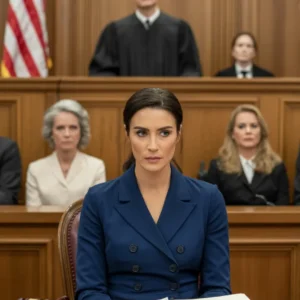
The courtroom was cold and institutional, all oak paneling and harsh overhead lights.
Judge Patricia Patterson presided—stern, early sixties, eyes sharp enough to cut through performance.
Sarah took the stand first in a demure navy dress, her voice trembling with practiced fear.
“Your Honor,” she said, “I’m terrified for my mother. She’s been forgetting things.
Making bizarre decisions. Talking about people following her. Since my grandparents passed, she’s deteriorated.”
It was manipulation dressed up as concern.
Dr.
Morrison testified next, describing observations he’d never made.
Then it was my turn.
I spoke calmly about running Wheeler & Company. About decisions I made daily. About staff, budgets, contracts.
Judge Patterson asked questions.
I answered clearly.
Janet introduced Dr.
Foster’s evaluation.
Then she submitted the bank records.
The withdrawals.
The forged signatures.
The money trail.
Judge Patterson turned to Sarah, her expression turning to ice.
“Miss Matthews,” she said, “did you steal fifty thousand dollars from your grandmother’s trust?”
Sarah’s mask slipped.
Her face flushed.
Her voice rose.
“That was family money,” she snapped. “And she’s gone now, so it doesn’t even matter.”
The courtroom went dead quiet.
Even Sarah’s own attorney looked horrified.
Judge Patterson didn’t raise her voice.
She didn’t need to.
“Petition denied,” she said flatly. “This isn’t filial concern, Ms.
Matthews. This is financial exploitation. If I see another filing like this, I will refer you for criminal prosecution.”
Outside the courthouse, Sarah grabbed my arm, nails digging hard enough to leave crescents in my skin.
“You humiliated me,” she hissed, face inches from mine.
“Big mistake, Mother. Huge mistake.”
The violence in her grip told me something I didn’t want to know.
Her next move wouldn’t be legal.
That night, my phone rang at three in the morning.
Marcus’s voice was rough, urgent.
“I found it,” he said. “Everything.
The evidence we need. But brace yourself. This is going to hurt.”
I sat up in bed, heart pounding.
“What did you find?”
“I’ve been surveilling Sarah since the courthouse,” Marcus said.
“Yesterday she went to a storage unit in Queens. I got access and searched the locker. Elizabeth… she kept a burner phone.”
A cold wave rolled through me.
“Why would she—”
“Insurance,” Marcus said.
“Leverage against Richard. If he ever turned on her, she wanted proof of what they did together. But it proves her involvement too.”
Twenty minutes later, I sat across from Marcus, a laptop between us.
He opened folders.
Text messages.
Voice recordings.
Photos.
Search history.
My hands shook.
Marcus scrolled to a thread dated months before my parents’ crash.
Cold planning.
Deadlines.
Talk of trusts and timing.
Then he clicked a voice memo labeled, in Sarah’s handwriting, practice.
Her voice filled the room.
“Oh, Mom… they’re gone.
They’re really gone.”
A pause.
Then her real voice, flat, amused.
“Too much. Try it more natural.”
Another file.
A plan, spoken like a project meeting.
“Once we control everything,” Sarah’s voice said, calm and clinical, “Mom becomes unnecessary.”
My skin prickled.
“And these,” Marcus said quietly.
He opened a photo folder.
Images filled the screen.
Me walking into my office.
Me sitting in a café.
Me unlocking my apartment door.
Me asleep in my bed.
Taken from angles that made my blood run cold.
“She broke into your apartment multiple times,” Marcus said. “These are surveillance photos.
She was tracking your routines.”
I stared at one image in particular.
My face in the soft darkness.
Eyes closed.
Unaware.
My daughter’s shadow behind the camera.
Marcus pulled up the search history.
Not details.
Not how-to.
But the intent was unmistakable.
Ways to make harm look natural.
How investigations fade.
What raises suspicion.
What doesn’t.
He closed the laptop.
“We can go to federal authorities now,” Marcus said. “With this, we can move.”
I looked at the black screen, seeing my own reflection.
Somewhere beneath it was that photo of me sleeping.
I lifted my eyes.
“I want to confront them,” I said. “Both of them.
I need to hear them admit it. I need them to say it out loud.”
Marcus’s jaw tightened.
“Then we do it with protection,” he said. “And we do it on record.”
That afternoon, a mechanic I’d trusted for years called.
His voice shook.
“Mrs.
Matthews,” he said, “you need to get here now.”
I was at the garage within twenty minutes, Marcus right behind me.
My car was up on a lift.
The mechanic—Frank, gray-haired, hands permanently stained with honest work—pointed under the chassis with a trembling finger.
“Someone messed with it,” he said quietly. “Not wear. Not age.
This was deliberate.”
My throat went dry.
Marcus crouched, eyes narrowing.
“She’s escalating,” he muttered. “She knows we’re investigating.”
That night, we met with federal agents.
No promises. No speeches.
Just procedures.
A device.
A plan.
“If you do this,” one agent said, steady and unsentimental, “you do it our way.
You wear the device. We monitor. If it turns physical, we step in immediately.”
I agreed.
Security tightened around my apartment and office.
And still, I left a gap.
I needed Sarah to make a move.
I needed it captured.
That evening, I stayed late at Wheeler & Company.
The office was nearly empty, just a cleaning crew and one junior designer finishing a deadline.
At 9:15, the elevator doors opened.
Sarah stepped out.
Her eyes were bright with something too sharp to be grief.
“Mom,” she said, voice tight, “we need to talk.
Privately.”
The device pressed against my ribs under my blouse.
Marcus was listening from a surveillance van two blocks away.
“Of course,” I said calmly.
We took the stairs to the third floor—mostly storage, fluorescent lights, an emergency exit that hummed with cold air.
Sarah’s hands shook.
“Why won’t you just give up?” she exploded, spinning toward me. “Why can’t you just let this go?”
I met her eyes.
“Because you and Richard took my parents from me.”
Sarah froze.
“The tampering,” I said quietly. “The money.
The storage unit. I know.”
Her face drained.
“You can’t prove anything.”
“I have your burner phone, Sarah.”
I took a step forward.
“Every message. Every plan.
Every photo.”
Panic flashed across her face.
“That’s impossible.”
“The storage unit,” I said. “You kept it as insurance. Now it’s evidence.”
For a moment, Sarah looked like she might crumble.
Then her expression twisted.
Rage, raw and primal.
“Then you know too much,” she screamed.
And she lunged.
I saw it coming, tried to sidestep, but her hands slammed into my shoulders with shocking force.
I stumbled backward, grasping for the railing.
My fingers slipped.
I fell—three hard steps—my body slamming into the landing.
Pain exploded through my ribs.
Above me, Sarah stood frozen, staring at her own hands like they belonged to someone else.
Then alarms blared.
Security had been monitoring.
Two guards burst through the stairwell door.
“Ma’am!” one shouted.
They grabbed Sarah as she tried to run.
The other knelt beside me, his radio crackling with urgent voices.
Paramedics.
Police.
I heard Sarah screaming even through the haze of pain.
“Dad will fix this!” she shrieked.
“He’ll make it go away!”
But she sounded terrified.
And terror makes people sloppy.
As they loaded me onto a stretcher, I saw Marcus in the doorway.
His face was grim.
“The cameras got it,” he said.
My breath came shallow.
“Now we get Richard,” I whispered.
Three days later, I walked into a neutral law office in Midtown with my ribs taped and the device hidden under my clothes.
Richard and Sarah thought it was a settlement meeting.
The agents in the adjacent room knew better.
Richard arrived first—haggard, defiant in an expensive suit that no longer fit his face.
Sarah came ten minutes later, eyes red-rimmed, expression carefully arranged.
They thought I was broken.
They thought I was ready to negotiate my surrender.
I wasn’t.
I placed the burner phone in the center of the conference table.
Richard stared at it.
“What is that?”
“I know everything,” I said quietly. “The money. The lies.
The tampering. Both times.”
Sarah’s breathing changed.
Sharp.
Fast.
I pressed a button on the laptop.
Text messages projected onto the wall behind me.
White words on dark screen.
Impossible to ignore.
Sarah’s face went blank.
“Where did you get that?” she whispered.
“Your storage unit,” I said. “You thought it was hidden.”
Richard tried to recover.
“You’re misunderstanding,” he began.
“I have the mechanic’s statement,” I cut in.
“Financial records. Withdrawals. The trail.”
Sarah’s control snapped.
“They were going to give it all away!” she screamed, slamming her hands on the table.
“To charity. After everything I did for them!”
Richard lunged, grabbing her arm.
“Stop talking,” he hissed.
“Why?” Sarah shrieked, ripping free. “It was your idea!
You said no one would suspect anything!”
Richard’s face twisted with panic.
“You were the one who pushed for it,” he shot back. “You wanted it done. You kept saying your mother would be easy to dismiss!”
The room filled with accusations.
Blame.
Confessions slipping out in their desperation to save themselves.
And every word was captured.
Then the door burst open.
Agents flooded the room.
“Richard Matthews,” one said.
“Sarah Matthews. You are under arrest.”
Sarah screamed as they cuffed her, thrashing.
“I hate you!” she spat toward me. “I always hated you!”
Richard went pale, his mouth opening and closing like a man finally realizing the ground was gone.
I stood slowly, every breath a spike of pain.
I looked at my daughter—this stranger wearing her face—and felt something vast and empty settle inside me.
“Goodbye, Sarah,” I whispered.
And I walked away.
The headlines came fast.
The story was irresistible to the public: a husband and daughter, a fortune, a betrayal at a cemetery, a confession caught on record.
Reporters camped outside the Holiday Inn until security forced them back.
I moved into my parents’ home in Westchester, a sprawling colonial behind gates and tall hedges, the kind of place where the neighbors waved politely and then pretended they hadn’t noticed police cars.
The assets my parents protected—accounts, shares, property—now sat in my name alone.
But money didn’t stitch a family back together.
I started therapy with Dr.
Rebecca Wilson, a calm, gray-haired woman in her fifties who specialized in trauma and family betrayal.
In our first session, the words barely came.
“My daughter tried to destroy me,” I whispered.
Dr. Wilson didn’t flinch.
“You’re grieving two losses,” she said. “Your parents, and the daughter you thought you had.”
Three weeks after the arrest, I returned to Wheeler & Company as chief executive.
The office felt different—quieter, sadder.
But the moment I stepped through the glass doors, my employees stood.
Applause rose like a wave.
Some were crying.
“We’re so sorry,” one junior designer said.
“We should never have believed her.”
Patricia pulled me into her office, face lined with guilt.
“I knew something felt off,” she said. “I should have said something sooner.”
“You were loyal,” I told her. “That’s not a crime.”
We rebuilt.
Slowly.
Client by client.
Contract by contract.
Stability returned.
Meanwhile, the legal machinery moved forward.
Richard’s attorney offered a plea—admit to the theft, try to soften everything else.
I refused.
No deal.
They took my parents from me.
I wanted a trial.
Sarah’s lawyer tried to paint her as manipulated.
I shut it down.
She planned.
She lied.
She watched me sleep.
Both of them filed motions blaming each other.
Their united front had shattered the moment the handcuffs clicked.
Sarah began sending letters from jail.
Thick envelopes.
Brooklyn postmarks.
I didn’t open them.
Week after week they piled up on my desk.
Katherine Walsh, the prosecutor assigned to the case, met with me regularly.
She was a no-nonsense woman in her mid-forties with a reputation for never losing.
“With what we have,” she said bluntly, tapping a folder thick with evidence, “they’re finished.”
Every Sunday, I visited my parents’ graves.
Fresh flowers.
A bench beneath an oak tree.
I spoke to them like they could hear.
“I’m still here,” I whispered one cold morning.
“Justice is coming. I promise.”
By April—four months after the funeral that started it all—the trial date was set.
Court began on a bright Monday that felt wrong for something so dark.
The courthouse steps were crowded with cameras and microphones.
Inside, the courtroom was packed.
Richard sat at the defense table in a charcoal suit, face rigid.
Sarah sat beside him in a modest navy dress, eyes downcast like she was auditioning for mercy.
Judge Harrison, late sixties, stern and tired of theatrics, called the room to order.
Katherine Walsh stood for her opening statement.
Her voice was sharp, clinical, devastating.
“This is a case about greed,” she said, “and about a husband and daughter who believed money entitled them to anything—including other people’s lives.”
The defense tried to counter with grief and manipulation.
The words sounded hollow.
The prosecution called the mechanic first.
He took the stand shaking, not a mastermind—just a man who made a terrible choice and carried it like a weight.
Katherine walked him through what happened.
Then she presented the financial records.
The withdrawal.
The timeline.
Marcus testified next, laying out the investigation with the precision of someone who had spent years chasing truth for a living.
A digital forensics expert authenticated the phone data.
Chain of custody.
Extraction.
Verification.
Then Katherine played audio.
Sarah practicing grief.
The courtroom went still.
A juror pressed a hand over her mouth.
Katherine read the messages aloud.
Planning.
Timing.
Cold language where love should have been.
Then came photographs.
Not gore.
Not spectacle.
But enough to show what was done.
Enough to show intent.
Finally, I took the stand.
Katherine’s voice softened.
“Mrs. Matthews,” she said, “please tell the jury about your relationship with the defendants.”
I looked at the twelve faces, then at the two people who had been my entire world.
“Richard was my husband,” I said.
“Sarah is my daughter. I loved them more than life itself.”
I described the cemetery.
The envelope.
The words.
The way Sarah’s voice sounded rehearsed.
During cross-examination, the defense tried to suggest misunderstanding.
I didn’t raise my voice.
“I didn’t misunderstand her hands when they pushed me,” I said evenly.
Then Katherine played the recorded confrontation from the conference room.
Every accusation.
Every panicked confession.
Every word that couldn’t be taken back.
The defense rested without calling a single witness.
They had nothing.
The jury deliberated for three hours.
Three hours.
When they filed back into the courtroom, not a single juror looked toward the defense table.
Judge Harrison asked, “Has the jury reached a verdict?”
The foreperson stood.
“We have, Your Honor.”
The clerk read.
Guilty.
On every count.
Sarah’s shoulders shook.
Richard’s face stayed stone.
Judge Harrison spoke at sentencing, his voice carrying through the room.
“In thirty years on this bench,” he said, “I have rarely seen cruelty so calculated.”
He looked directly at them.
“I have reviewed the evidence. What strikes this court most is the absence of remorse.”
He straightened.
“Richard Matthews, you are hereby sentenced to two consecutive terms of life imprisonment without the possibility of parole.”
He turned.
“Sarah Matthews, you are hereby sentenced to two consecutive terms of life imprisonment without the possibility of parole.”
Sarah’s scream tore through the courtroom.
“No,” she sobbed.
“I’m only thirty-three!”
Bailiffs grabbed her as she lunged forward.
“Mom!” she shrieked. “Please! I’m your daughter!”
I didn’t turn around.
Richard was led out in silence.
Outside the courthouse, reporters swarmed.
One shoved a microphone toward me.
“Mrs.
Matthews,” he asked, “will you ever forgive her?”
I looked back at the heavy courthouse doors.
Some questions, I realized, didn’t come with clean answers.
“I don’t know,” I said quietly.
Six months after the trial, I sat at my father’s old desk at Wheeler & Company.
The logo had been redesigned.
The office renovated with clean lines and brighter light.
But the building wasn’t what had changed.
I had.
I was fifty-eight now, a different woman from the one who stood in the rain at a cemetery and was handed divorce papers like a bill.
That version of me had been shattered.
This version had rebuilt herself.
The firm was thriving.
Revenue was up.
New hires.
New contracts.
We expanded into Boston and Philadelphia, then Chicago.
The work my parents began didn’t die with them.
I also launched the Eleanor and Jonathan Wheeler Foundation, focused on preventing elder abuse and helping victims of financial exploitation find legal support and protection.
Every family we helped felt like honoring my parents one more time.
Therapy continued every Tuesday afternoon.
In one session, Dr. Wilson asked the question I kept avoiding.
“How do you feel about Sarah now?”
I stared at the window, watching rain streak down the glass like it couldn’t stop repeating itself.
“Like I’m mourning a death,” I said finally. “The daughter I loved never existed.
I loved an idea.”
Dr. Wilson nodded.
“You’re allowed to feel grief and anger at the same time,” she said.
I visited my parents’ graves every Sunday.
The same bench.
The same oak tree.
I talked to them as if they could answer.
“We’re rebuilding,” I told them. “I’m trying.”
The letters started arriving about two months after sentencing.
The first envelope came from Bedford Hills Correctional Facility.
Sarah’s handwriting.
I stared at it for an hour and didn’t open it.
Eventually I placed it in a drawer labeled, in Patricia’s neat handwriting: From Sarah.
More letters followed.
One a week.
Sometimes two.
They piled up until the drawer wouldn’t close.
One night, something shifted.
I sat alone in my parents’ study, a glass of wine on the desk, their photographs watching from the mantel.
I picked up the latest envelope and tore it open.
Four pages.
Shaky script.
Dear Mom,
I don’t deserve your time or your forgiveness.
I know that. But my therapist says I need to write this anyway, not for you, but for me—to face what I did.
I killed Grandma and Grandpa. I planned it.
I knew what would happen. And when it was over, I felt nothing.
Now I wake up and feel everything.
I don’t know if I’ll ever be worthy of forgiveness, but I need you to know I’m sorry.
Love,
Sarah
I folded the letter carefully and set it down.
Then I sat in the dark and let the tears come.
Was she sorry?
Or was she sorry she was caught?
I drove to Bedford Hills three times and turned back.
On the fourth try, eighteen months after sentencing, I walked through the doors.
Procedures.
A visitor badge.
Metal detectors.
A guard led me down a corridor lit with fluorescent lights that made everything look harsher than it was.
The visiting room had glass partitions dividing narrow booths.
Black phones mounted on both sides.
I sat down.
My hands trembled.
The door on the other side opened.
Sarah appeared.
She looked thinner.
Almost gaunt.
Gray threaded through her hair.
Lines around her eyes that hadn’t been there in court.
Prison had aged her in ways time alone couldn’t explain.
We stared at each other through the glass.
Finally, she picked up the phone.
I did the same.
“You came,” she whispered.
“I almost didn’t,” I said. “This is my fourth try.”
“Why now?”
“To see if the daughter I once loved is still in there,” I said.
“Or if she ever was.”
Sarah’s face crumpled.
“I don’t know,” she said. “I’m trying to figure that out.”
“You say you’re sorry,” I said. “Is it real?
Or are you sorry you’re here?”
She was quiet for a long time.
When she spoke, her voice was raw.
“I’m trying to figure that out honestly,” she said. “Some days I’m horrified. The guilt crushes me.
Other days I feel nothing. And some days…” She swallowed. “Some days I’m still angry at you.”
It was the first honest thing she’d said in years.
“Why did you do it?” I asked.
“The real reason.”
Sarah looked down at her hands.
“I was empty,” she said. “I thought money would fill it. Power.
Proving I was better than you.”
She looked up, eyes wet.
“But I’m still empty.”
She inhaled.
“Now I’m also someone who can’t undo what I did.”
We sat with that.
Glass between us.
Choices between us.
“Will you come back?” she asked quietly.
“Not next week,” I said. “Maybe not for years. But… someday.”
Sarah nodded, tears streaming.
“That’s more than I deserve,” she whispered.
I hung up the phone and walked out past the security checkpoints into the parking lot where sunlight felt too bright after the fluorescent prison halls.
Sitting in my car, hands on the steering wheel, I realized something.
I had left the door open.
Not forgiveness.
Maybe not ever.
But not total abandonment either.
Was that weakness or the strongest thing I’d ever done?
I didn’t know.
Two years after the trial, I stood at a podium facing five hundred people.
A ballroom filled with soft hotel lighting and round tables, name badges, and quiet expectation.
I was the keynote speaker at a national resilience conference.
Wheeler & Company now operated in three cities.
We’d been named one of the top design firms in the country.
The foundation had helped hundreds of families navigate exploitation and regain control of their lives.
People looked at me like I was a symbol.
I still felt like a woman who sometimes woke up expecting her phone to buzz with bad news.
After the speech, I drove to the cemetery.
I brought peonies when they were in season—my mother’s favorite.
I placed them on the graves.
Then I sat on the bench under the oak tree and pulled out Sarah’s latest letter.
She had written about seeds.
About how growth requires darkness.
About how transformation happens in buried places.
I folded the letter and looked at my parents’ names carved in stone.
“I’m trying,” I whispered.
“I’m doing my best.”
Driving away, I thought about the question people always asked.
Have you forgiven her?
The answer wasn’t simple.
She was my daughter.
She did what she did.
She was changing.
She was serving life without parole.
All of those things were true at once.
At fifty-seven, they tried to bury me under grief, under betrayal, under a narrative that said I was too old to matter.
They didn’t understand something my parents taught me without ever saying it out loud.
You don’t disappear because someone decides you should.
You don’t stop being powerful because life gets violent.
And you are never too late to reclaim your own name.
Sometimes the darkest place isn’t the end.
Sometimes it’s where the roots finally take hold.
And seeds, when buried, don’t die.
They grow.